Friday, March 15, 2019

A Disastrous Friday Night of Chess?

First and foremost, my condolences to the victims, family and friends of the Christchurch shooting incident.

Today, I played 3 rapid games (20 minutes per side with no increment) with Ms Zhemin, a regular at Singapore Chess Meetup and Thomson CC Chess Club. Results-wise, it was indeed disastrous in that I lost 2 games. In fact, I might have lost all 3 games. I will explain the "controversial" result in game 1. Personally, I really enjoyed game #2 despite losing. And I guess my friends who follow a little bit of my games will understand why.

Before I show the game moves, I do want to share the following thoughts:
  • I was surprised to learn that chess is indeed a rather sexist game even at the social level. I have more than a couple of male chess friends who admitted to me in private that they cannot stand losing to female chess players in particular. But I am happy to say, I have no such gender-related ego problem at all. Which is why I can be candid about my losses today like a man ^o^
  • If anything, I am more curious to find out how my opponent managed to improve so much over a short span of time. Or did my play really deteriorate so much after my diversion into "arbiterhood" and organising chess events?
  • There is nothing "unfair" about a chess game. We start off with equal time, symmetrical positions. I used to lament after some losses that "it won't happen in a standard game". I've manned up and stopped being such a sore loser! In fact, it was unfair that I took White twice (and still got my ass kicked).
  • After sharing my 'misadventure' tonight, I have a couple of (adult) chess friends who are eager to challenge her already ^o^
Game 1: newbie_learner v.s. Ms ZM

1. d4 d5 
2. Nf3 e6 
3. g3 Back to 1 of my old love (does that count as a "fling", lol) the Catalan. 
3...Nf6 
4. Bg2 c5 
5. O-O Diagram


I am not particularly scared of Black taking the pawn majority with ...cxd4. My argument is that I get to centralise my Knight to d4 (and unleash my Catalan Bishop. If Black plays ...e5, he has already cost himself with ...e6 first, so it is not a complete waste of time on White's part. 

5...Be7 
6. dxc5 Again, I justify the initiation of this capture as Black has spent one move on ...Be7.
6...Bxc5 
7. a3 Diagram 


Similar to Queen's Gambit Declined ideas (...dxc4 Bxc4, followed by ...a6 and ...b5 to
achieve ...Bb7), I am going to play b4, Bb2, Nbd2 and c4 to develop and strike
back against Black's centre pawn majority. 

7...Nbd7 
8. b4 Be7 
9. Bb2 If I can develop and delay ...e5 while preparing to strike back against Black's centre
with c4, why not. 
9...b6 A very logical thing to do. In anticipation of White striking back in the centre, Black places the light square Bishop on b7 for an equally awesome b7-h1 diagonal. 
10. Nbd2 Bb7 
11. c4 Rc8 
12. cxd5 Diagram


I do want to reduce Black's centre pawn majority at all cost. On hindsight, perhaps I
should have also considered 12.Ne5!? to take this chance to exploit the
pressure on the diagonal. Fundamentally, my White King is already defending my
g2 Bishop, while Black's Bishop on b7 is still undefended. White should have a
small advantage when the 2 light square Bishops face off in the diagonal. 

12...Bxd5 
13. Rc1 The c-file is important enough for both sides to fight over it. 
13...O-O 
14. Qa4!? Diagram


An interesting way to exert a little bit of pressure while completing the opening development by connecting the backrank Rooks. I even saw the possible responses from Black but I really wanted to see how it goes.

14...a5 
15. bxa5 Here, I am anticipating either ...Nc5 or ...Ra8. And I guessed right! 
15...Nc5 Saw this coming, and I was asking myself who is actually better. 
16. Qb5 Exploiting the possibility to go Qxb6. So the White Queen is not trapped at the very least. 16... bxa5 
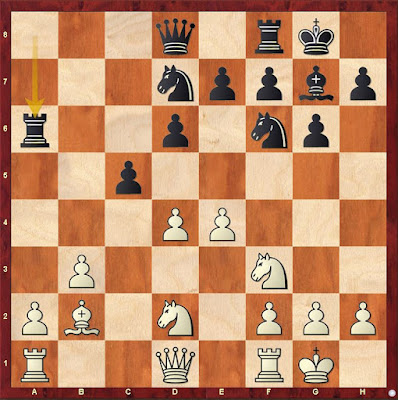
17. Bc3!? Diagram


Even though I felt uncertain about this move, I justified my move based through elimination. If I do not move out either the White Queen or the dark square Bishop out of the b-file, Black is going to cause some disruption with ...Rb8. Rather than waiting for that to happen, why not take this chance to get the undefended Bishop out of harms way. Also this counter-exerts some pressure against Black's a5 pawn.

17...Rb8 
Engine: If Black found 17...a4! fixing White's weak pawn on a3 while threatening to advance the a-pawn,  White would face an uncomfortable position.

18. Qxa5 Ra8 
19. Qxd8 Rfxd8 
20. Bb4 Diagram


The way I see it, White cannot be worse. The worst-case scenario that can happen is that Black recaptures White's pawn on a3 and that's still equal.

20...Nfd7
21. Rc2 I am trying to double Rooks. Because my time situation is quite bad, I just want to make sure I do not blunder while maintaining small pressure against Black. 
20... Kf8 
22. Rfc1 Nb3 
23. Bxe7+ Kxe7 
24. Nxb3 Bxb3 
25. Rc7 Diagram


I feel that I achieved what I wanted: get into a position whereby I can exert a little bit of pressure against Black.

25...Bd5 
26.Ne5 Bxg2 
27. Kxg2 Ke8 Black played correctly here to avoid getting into trouble. =( Here, being severely down on time, I chose to simplify into a Rook endgame with 1 pawn up. 
28. Nxd7 Rxd7 

Engine: The best way for White to retain maximum advantage is to keep the Knight and play 28.Nc4. But it is understandable that White wanted to simplify under time pressure.

29. Rxd7 Kxd7 
30. Rc3 Diagram

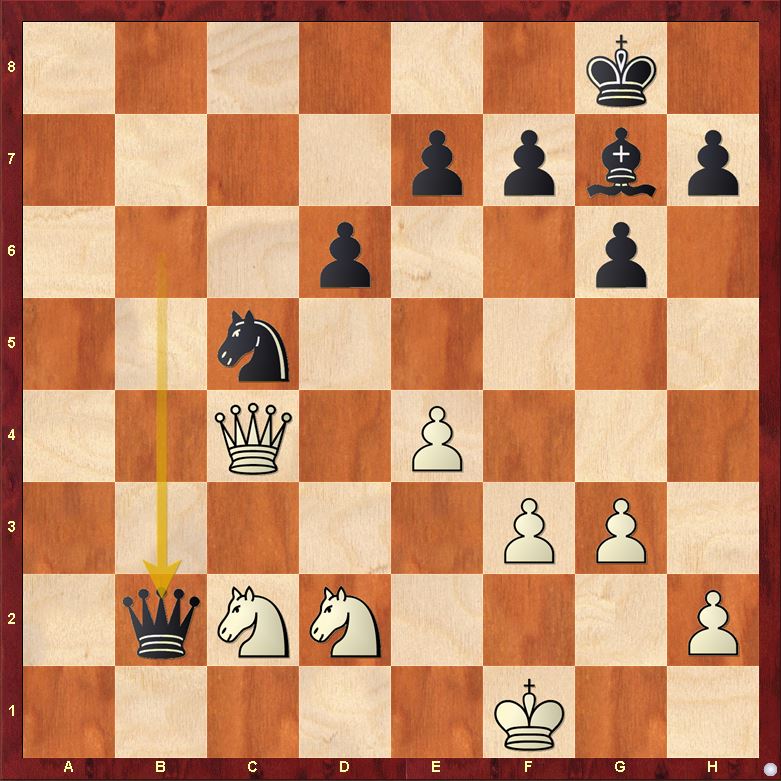
This was the final position I managed to record. I did not have the luxury of time to continue recording as I was in severe time trouble. 

Eventually, we reached a position that while White cannot lose objectively, but White only
had 2 or 3 seconds left on the clock. So I played in a totally gamesmanship
way:


(This may not be the exact game position, but it illustrates the point.)

Objectively, White may have a winnable position. BUT in the game, White has only around 2 seconds left on the clock. And because there is no time increment per move, White is going to lose by time forfeit. So it should not be too difficult to guess what move I played out of pure gamesmanship...

x.Rh4! Objectively, it should be given a ?! for completely giving up winning chances. However, if you take the time situation into account, this was the only trick I have for White.

x...Ra4+
x+1. Kf3 Rxh4?!  Objectively correct, but as I explained to Zhemin after the game, she could've just made any other Rook move -- basically, just keep the Black Rook alive on the Board and she would've won by time forfeit. But obviously, she wasn't playing on the technicalities here. Good for her!
x+2.gxh4 White Flag falls, 1/2-1/2 

To be honest, even though I am trained as an arbiter, I was not absolutely sure that I managed to play x+2.gxh4 before my timer hits zero. I mean, I was focused solely on making the moves as fast as possible, I genuinely did not bother to check the clock. It could well be possible that had there been a camera or observer looking, my flag may have fallen before I made the move of x+2.gxh4. 

External Link to the game can be found below:
http://view.chessbase.com/cbreader/2019/3/16/Game7308687.html

Perhaps Caissa did not like my antics here. In any case, I got my ass rightfully kicked in the 2 games to follow =) 


Game 2: Ms ZM v.s. newbie_learner

Pre-game thoughts: Following Game 1 not winning despite having some promising advantage at certain point, I was eager to play for a win (even at increased risks of losing). Something a turtle like myself usually don't pursue. I mean, if I do not play for a win in a casual setting like this, I would never have the guts to do it in a tournament. I have more to win than to lose.

I did feel that I was playing too slowly. In a time control with no incremental situation, every second consumed is lost for good. Throughout my games 2 and 3, I was trying to play faster but in both games, I ended up in worse time situation. I don't know how my opponent just manage to play so much faster with decent accuracy. That was probably a side frustrating point throughout, when I made a conscious effort to not fall (too much) behind on the clock and constantly failed.

1. Nf3 Nf6 
2. d4 d5 
3. Bf4 c5 
4. e3 cxd4 Diagram


My justification is that rather than waiting for White to build the pawn triangle typical in the London System, why not initiate the reduction of White's central pawn majority before c3 is played? After c3 is played, White has additional option to react to ...cxd4.

5. Nxd4
This was new to me. Not wrong, just new.
5...Nc6 
6. Bg3 Qb6 

Engine: 6...Qb6 is not good because White can just play 7.Nc3 and Black probably won't have the time to be greedy with ...Qxb2.

7. Bb5 Bd7 
8.Bxc6 bxc6 Diagram


I was eager to retain the Bishop pair for a good fight!
9. b3 e6
10. O-O Be7 
11. Bh4 I feel that White has spent too much time on the not so important things in the opening phase of the game. Give other pieces a chance to develop instead! 
11...O-O Diagram


And Black is faster than White in completing opening development. By 2 moves.

12. Nd2 e5 When we are faster, we open up the position! Also, Bishops prefer open positions.
13. N4f3 Bd6 

Engine: The correct way for Black to play is 13...e4 immediately. White has already lost the Bishop pair. So there's no need to allow White to inflict more damage with the remaining Bishop -- Black's Bishop should have stayed at e7 as far as possible to avoid damaging of pawn structure.

14. Bxf6 gxf6 Diagram


Both sides have things to be happy about. White has damaged Black's pawn
structure and weakened Black's Kingside. Black retains the Bishop pair and has
supremacy over centre pawns. 

Engine: 14.Bxf6 is a good move. 14.Nc4! would be another good move forcing to take away Black's Bishop pair.

15. c4 White's undermining efforts of Black's centre pawn majority begins. 
15...Qb7 My intention is to avoid any danger (e.g. 15...Qc7 runs the risk of allowing White to open the c-file with cxd4 followed by Rc1.) But on hindsight, maybe 15...Be7 was better in that it immediately defends the weak f6 pawn. 

16. Nh4 With ideas like Qh5, f4, Nd2-f3, Nf5 etc. 
16...Kh8 With options like ...Rg8 for counter-play.

Engine: 16...Be6 would have prepared to fight off White's Kingside attack.

17. Qh5 Be6 
18. Nf5 Bb4 Diagram


Trying to buy myself a tempo. Which is really quite risky as White has ideas like Qh6orh4-Qxf6+

19. Rad1 Rg8 Now there is the resource of ...Rg6. During the game, I got carried away realising the threat of ...Bg4. Which led to a horrible blunder costing me the game. 
20. f4 e4 Done to keep the f-file closed AND take away the f3 square from White's pieces
(f1 Rook and d2 Knight). 
21. Nd4 Bg4 Diagram


I still believe 22...Bg4 is a good move, but because I did not calculate enough, I got worried by White's next move during the game.

22. Qh4 Only after this move was played over the board, I realised that 22...Bxd1 may not be such a
great idea after 23.Qxf6+! Rg7 (only move) 24.Nf5 and what exactly am I
supposed to do after this move? I thought it looked really horrible, if not outright losing for Black. But then, I also did not want to lose my opportunity "winning". So I rejected a "normal" response like 22...Be7 which simply holds off the f6 square and threatens ...f5 to kick the White Queen off
(because 22...Be7 White can now move the d1 Rook without losing the Knight on
d2). But what I played was such a horrible blunder. 
22...Qe7?? which was immediately punished critically.
23. Nxc6 Basic fork! Honestly, I was contemplating between resignation on the spot, or just play on a few more moves for "completion" sake. After the game, I suggested that 22...Rg6! seems
winning for Black. If 23.f4 Rg5!? And I like Black's prospects.

Engine: Indeed, my post-game analysis is correct. 22...Rg6 or 22...Be7 are the best moves for Black. Winning too. 

23..Qd6 
24. Nxb4 Bxd1 
25. Nxd5 Be2 25.Nxd4 first may work out nicely, but White is in such a dominating position, "everything" works. 
26. Rf2 Bd3 The rest are really inconsequential moves
27. Nxf6 Rg7 
28. Nh5 Rg6 
29. f5 Rh6 
30. Qf4 Black eventually lost the game. 
1-0

Some additional thoughts and learning points:
  • Even though objectively, game 2 contained more mistakes, both Zhemin and I liked this game most. I guess deep in most chess players hearts, we want to play more interesting chess, even if that is objectively inferior. 
  • My handling of dynamic positions cannot be compared to the "safe, quiet" type of "turtle" positions I fare better with. But if I do not at least try them out in casual, non-consequential games, such weaknesses will linger on.
  • Game's 2 loss made me feel more obliged to try and win game 3, only to backfire (Similar pattern to game #1, got a pawn and some advantage, failed to convert and entered into what should be an objectively equal ending. Then I came under huge time pressure, over-pressed and lost). It goes to show that the mentality / expectations one carries (playing to win | playing to not lose | playing your usual self) can greatly affect one's play.
External Link to the game can be found below:
http://view.chessbase.com/cbreader/2019/3/16/Game14850437.html


Game 3: newbie_learner v.s. Ms ZM

1. d4 e6 
2. e4 I used to play the French Defence before I switch to the Caro Kann. Hence, this will make for an interesting and practical choice. 
2... Nc6 Okay, I have never seen this, which means this must be objectively bad! But
even if it is bad, I need to work things out over the board.
3. d5 exd5 
4.exd5 Nce7 
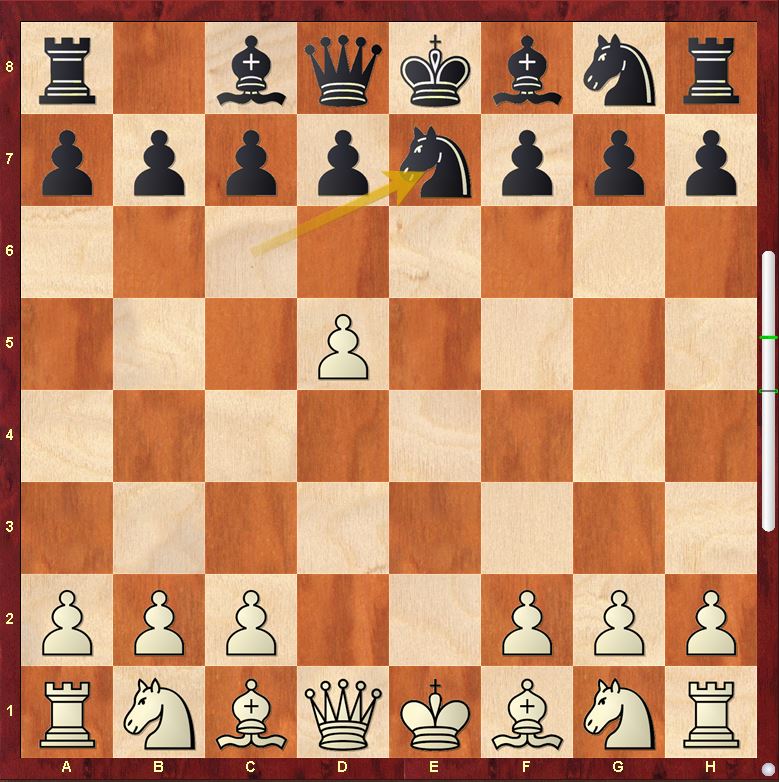

I was expecting ...Ne5 instead. 

5. Nf3 Nf6 
6. Bc4 a6 
7. a4 d6 

Engine: Instead of a normal move of 7.a4, the engine recommends an immediate 7.d6 to wreck Black's pawn structure for good.

8. Nc3Bd7 
9. O-O g6 
10. Bg5 Bg7 

Engine: Again, not "ordinary" moves. 10.Ne4! There is no 10...Nxe4 because of 11.Qd4 winning back the Knight on e4 and disturbing Black's Kingside development. White can slow down Black's development, which contributes to the most value for White. 

11. Qd2 O-O Diagram


White completed his opening development first. But what should he do next? Play Bh6 to trade Bishops? Play Rfe1 to control an open file? 

12. Rfe1 Since Black has resources like ...Nf5, I don't think Bh6 is going to be that effective. I thought controlling the open e-file makes more sense.
12...Re8 
13. h3 To take away the g4 square from 2 of Black's pieces. 
13...b5 Diagram


An interesting counter which is quite thematic. 

14. axb5 axb5 
15. Nxb5!? I do not think this is objectively "correct" But I think it is playable. I just don't want to give Black an easy ...Bxb5 and still get to capture on d5 as the White Bishop on b5 gains a tempo on the Black Rook on e8.

Engine: 15.Rxa8 Qxa8 16.Bxb5 would've given more advantage to White. The problem with getting the White Knight pulled to b5 for no good reason is that Black has a useful resource of ...Ne4 forking White's Queen on d2 and Bishop on g5.

15...Rxa1 
16. Rxa1 White gets the open a-file while Black gets the open e-file.
16...Nf5 Diagram


Here, I was really unsure what to do. I know that ...h6 is coming, and also ideas like ... Qb8, ...Ne4 etc. Hence, I simply relocated my Knight back, having won a pawn.

17. Nc3 h6 
18. Bxf6 Qxf6 
19. Ra7 Just being irritating while showing that White has no concrete plans despite the 1 pawn advantage. I did check that Black Rook does not seem to have any useful square within
White's turf. 
19...Qd8 
20. Ra3 Diagram


In fear of ...Qb8, I have Rb3 as a resource.

20... Qb8
21. Rb3 Qa7 
22. Kh2 I do not want to entertain ...Ng3 ideas. Kill this threat at the onset!
22...Qa5 Diagram


Here, I decided to "go for it".

23. Nb5!? Qxd2 
24. Nxd2 Bxb5
25. Bxb5 Rb8 
26. c3 Diagram -- this was the last position recorded.
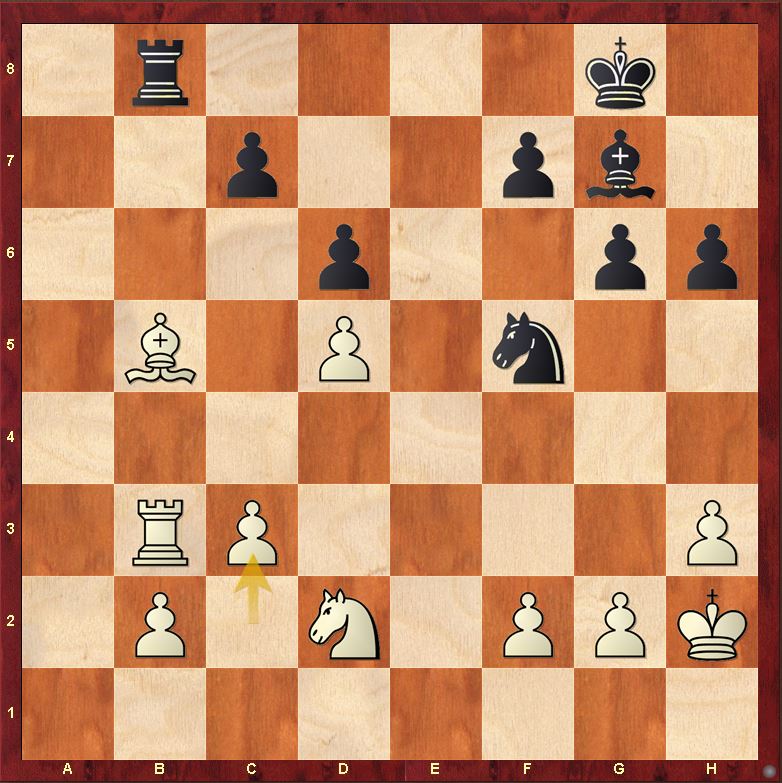

While having the pawns on the same colour as the opponent means that the pawns can become targets, (mini) pawn chains can also take the scope away from opponent's Bishop. This is my choice to combat the fianchetto Bishop on g7. And believe it or not, White eventually managed to lose out of
his all-in "play to win" mentality in the endgame. I don't think this is necessarily a bad mentality. It just means I am currently not tough enough to play this way. So I will toughen myself up to play like this! 

0-1

External Link to the game can be found below:
http://view.chessbase.com/cbreader/2019/3/16/Game18334000.html

Maybe it's time to refer to Juga's Oh Capablanka Video again for comfort ^o^


Looking forward to your generous feedback for my learning / improvement! Thank you.


Yours sincerely
Ong Yujing (Eugene)
a.k.a. newbie_learner
Siglap South CC Chess Quartet

Thursday, March 14, 2019

Games Played at Singapore Chess Meetup (13 Mar 2019)

Recently, I've come to the realisation that I've played too much blitz chess for my own good. Hence, I'm doing my best to gravitate back towards slower (rapid and hopefully standard) chess.

As always, below are my self-attempt to review my own game, as well as another game I happened to watch between 2 other chess friends and regulars at the Singapore Chess Meetup.

I am trying to improve on the game myself, so please do not take my comments as "advice". Rather I am trying to review my thinking process and seeking to improve along the way. Should you have any comments or feedback, please feel free to leave them. Thanks ahead!

The first game is the one and only I've played against a Teenager I've not met for a LONG time. Time control is 15 minutes initial thinking time with 10 seconds increment per move starting from the first.

Teenager (White) v.s. newbie_learner (Black)

1. e4 c6 
2. d4 d5 
3. e5 Bf5 
4. Nf3 e6 
5. g3... Diagram


A move I've never seen. During the game, my young opponent was lamenting how this is a mistake. I don't know if this is indeed a mistake, but I do acknowledge that there was no need for White to play g3 in order to develop his light square Bishop.

5...h6 
A weird move "demands" a weird response? =) I did it as a possibility to preserve my Bishop pair, in anticipation of Nh4.

6. c4 Ne7 
7. Nc3 Nd7 Diagram


I often deploy my Knights this way playing on the Black side of the Caro Kann. The break is usually ...c5 but because White has already played 6.c4 and his Kingside development is faster, I prefer to delay the opening up of the position. "When you are ahead in development, you open up the position. When you are behind in development, you keep the position closed." This general principle is something I tried to apply in this case.

8. Nh4 Bh7
9. f4 Nf5 This was done as an attempt to open up the scope of my dark square Bishop. "When we are short of space, initiate exchanges so that our fewer pieces remaining have more breathing space!" Another general guideline I tried applying here.

10. Nxf5 Bxf5 
11. cxd5 cxd5 My rationale of playing 11...cxd5 instead of 11...exd5 is that I do not even want to entertain the possibility of e5-e6.

12. Qb3 Qb6 Diagram


Admittedly, I played 12...Qb6 too casually, and deserved to be punished. I think on hindsight, I would have preferred 12...Rb8. White's series of moves exposes the potential problems of playing Bishop outside the pawn chain -- I have no more light square Bishop to help serve as a defender for my Knight on d7 in the e8-a4 diagonal.

Engine: Although 12...Rb8 is not the strongest, it does suit my playing style best. The engine opine it is okay for Black to continue with normal development (...Be7, ...0-0) and offer Qxb7. I have to admit I am not strong enough to understand such gambiting style (even though I know the opening principle of development over greed). 

13. Bb5! Qc7 The problem is, that Black has no obvious way to complete his opening development. Where am I supposed to place my Black Queen? But I think 13...Qc7 made the situation even worse. Somehow, this happens sometime. When a position or situation is already bad, I make it worse =( Here, I think of good ideas for White, including but not limited to just Bd2/Be3, Rc1, playing natural developing moves while harass the Black Queen on c7.

Engine: Indeed, 13...Qc7 made a challenging position worse. The best to the engine is 13...Kd8!? which, despite giving up castling rights, does address the problem: White no longer has the Bxd7 resource with check.

14. Bxd7+ Qxd7 This I find too kind from White. The exchange on d7 solves Black of all the existing problems. Now the Black Queen has found a stable home on d7, there is a clear path to complete opening development (...Be7, 0-0). It simply cannot compare with keeping the tension.

Engine: 14.Bd2/Be3 followed by 15.Rc1 is indeed better for White.

15. Bd2 Be7 
16. Rc1 O-O Diagram I regard Black as almost equalised already. Time to start fishing for more.


17. O-O Rfc8 Now this must be completely equal for Black at least. Not to forget, Black has the Bishop pair and prior control to the only open c-file. And I do not see a single (pawn) weakness at all.

18. Rf3 Rc6 I want to double Rooks, and I find it easiest to place it on a square already supported by my own pawn. On a good day, I may even triple my major pieces if necessary.

Engine: 18...Rc4, achieving similar doubling of major pieces while threatening the d4 pawn, is even stronger.

19. Qd1 An unfortunate self-disrupt that one must be alert enough to capitalise! Bg4 Diagram


Black wins an exchange, and that's that in a quite position with no much going on.

20. Kg2 Rac8 The material advantage is not running away, so let's take this chance to further improve Black's position. I am placing the worst placed piece I identified (the Rook on a8) onto the only open c-file, as planned.

21.Qe1 Bxf3+ Last chance to go up the exchange, let's do it!

22. Kxf3 a6 Diagram


My intention is to expand on the Queenside with ...b5.

Engine: 22...a6 can be avoided as a preparatory move and 22...b5 immediately can be considered.

23. Qf2 b5 
24. b3 Here my young opponent was intending to play b4, but realised the presence of the dark square Bishop on e7 and changed his mind with b3 instead. Of course, this is fully permissible, since White has yet to release the piece. Ba3 
25. Rd1 As 25.Rc2 would have gotten into even more trouble after 25...b4 (c3 Knight is pinned, cannot be moved because the Rook on c2 is hanging).Rxc3+ 
26. Bxc3 Rxc3+ 
27. Kg2 Qc6 Diagram


Black is simply a Bishop up. Here my thinking is to avoid any possible approach for White to try and save the game.

28. h4 Rc2 
29. Rd2 Rxd2 
30. Qxd2 b4 Diagram


My thinking is to prevent the White Queen from "escaping" into Black's territory, as Black slowly but surely will out-maneuverer White. The remaining moves as follows.

31. Kh3 Qc3 
32. Qf2 Qd3 
33. h5 Bc1
34. Kh4 Bd2 
35. g4 Qe3 
36. Qf1 0-1

Some other learning points / personal interpretation:
  • A key factor of this variation of the Caro-Kann Defence seems to be whether to initiate ...c5 pawn break, and when to do it.
  • While bringing the Bishop out before chaining the pawns in may be seen as an "ideal" way of opening development in that we have no "bad Bishop", it is not without any drawbacks. The lack of the Bishop to serve as a defender within your turf can be bothersome.
  • When a position is bad, don't (try to) make it worse! 13...Qc7 was real bad. 13...Kd8!? is the kind of move I hope to find one day -- may I be relieved from the shackles of general principles soon!

Full game replay can also be viewed here: 


The next game I'm reviewing is a long game played between 2 of my chess friends, William (White) and Weng Chew (Black). I was slightly surprised it was played without the use of a clock, as that would have maximised learning value through mimicking the same playing conditions in a tournament, as well as requiring the players to time-manage. Time management, playing under time pressure is really a practical and important aspect in tournament play.


William (White) v.s. Weng Chew (Black)

1. d4 d5 
2. Nf3 Nf6 
3. e3 e6 
4. Bd3 Be7 Diagram


First minor difference straying away from a possible mirror position. Is this very important? I don't think it's much, but looking at things superficially, the Bishop on d3 does look more
active than the Bishop on e7. On the other hand, perhaps the Bishop on d3 may be a little but more vulnerable to some sort of Knight / pawns harassment as compared to e7. 

LiveBook: Surprisingly, statistically 4...Be7 fares much better than 4...Bd6. But I have not figured out any concrete reason why. 

5. O-O O-O 
6. b3 Okay, so William is playing the Colle-Zukertort, something he found comfortable with these days. When will I finally find an opening I'm truly comfortable with? My exploration continues... =) 

6...h6 Okay, this move seems a little bit unprovoked. Why not do other things
first? Black's opening development has yet to complete -- he can develop the
Queenside pieces, play ...c5 to challenge the centre etc. ...h6 here feels a
bit too defensive. 

7. Bb2 b6 Makes sense. The light square Bishop has no prospects with the c8-h3 diagonal, so it is heading for the b7-g2 diagonal instead.

8. Nbd2 Bb7 
9. Ne5 Diagram


I'm not that familiar with this opening. But after seeing the course of the game and hearing some tips from other stronger and more experienced players, I thought that it might've been better had Black
played ...Nbd7 first -- this gives Black the option to play an immediate ...Nxe5 before White gets to play f4. And then we get ...Nfd7,, ...c5 etc. Also, had the dark square Bishop been placed on ...d6 instead of ...e7 right at the start, ...Bxe5 would be an additional option.

9...Nbd7 
10. f4 This also resembles the Dutch: Stonewall attack. Something that is an extremely
effective sideline played against me =) 

10...c5 
11. Ndf3 White has formed this "iron grip" in the middle that is not so easy to challenge. cxd4 
12. exd4 Diagram


Black has achieved centre pawn majority. But in reality, I find it so difficult for Black to expand on the Queenside! (While White makes progress in the middle and the Kingside). 

12...Qc7 
13. Nxd7 Nxd7 
14. Ne5 Bd6 Diagram


I'm not sure about the purpose of this move: Does it somehow discourage f4-f5? 
15. Qh5 Nf6
16. Qh4 Be7
17. Rf3 Ne4 
18. Qg4 f5 
19. Qh5 Nf6 
20. Qh4 Diagram


Are you as lost over the pieces jumping around as I am? I simply need to insert the diagram here to prevent myself from getting lost! Jokes aside, here, I wonder if there's any issues if White tries something like 20.Qg6 threatening Rg3 and take aim at the g7 pawn. 

Engine: 20.Qg6 is indeed very strong for White. Nice find, newbie! But White needs to know what to do as follow-up. E.g. 20...Bd6 (the Queen on c7 protects g7) 21.g4! The point is to open up the d3-h7 diagonal to allow Qh7+ ideas.

20...Ng4 
21. Qe1 Nxe5 
22. fxe5 Diagram


A good decision to keep the Queens on the board! This increases the difficulty for the defending side (Black).

22...Qc8 
23. Rh3 Ba6 
24. Qg3 Kh7 Diagram


Seems necessary to hold the Kingside pawns. But the f5 pawn is temporarily pinned. 

25. Qe3 Bxd3 
26. Qxd3 This series of moves, I feel that White did not play the best. Since White is intending to play Qxd3 (and obviously not cxd3) anyway, why not just play Rf1 first (and
save a move on 25.Qe3)? 

26...Qc7 
27. Rf1 Rac8 
28. c3! Diagram


Simple yet effective. Black will not get the c-file where his pieces have doubled his major pieces.

28...Rf7 
29. g4! Very nice move but it does take a bit of guts to play as White opens up his own King cover. The f5 pawn is pinned. 3 attackers v.s. 2 defenders. 

29...Rcf8 Okay, Black realises this and decides to increase his defender count. 
30. Bc1! I love this move seeing it played live. White knows what he's doing. Yes, it may appear as a "simple, logical" move to most. Even if Black plays correctly, White must be the one calling the shots here.
30....Qd8 Diagram


I guess Black's thinking is to discourage g4-g5.

31. Rhf3 This is where a couple of us were speculating that 31.Rh5 should be better. Not only does the Rook on h5 pressurise the pawn on f5, it also clears the way for possible follow-up like Qd3-h3, and even something like g4-g5 becomes a possibility  (out of "nothing"). Still, I do not think Rhf3 is a bad move. Not at all. Especially seeing how the game turns out, that's great!

Engine: After 30...Qd8 (30...Kg8 was easier to play), 31.RRh5 was indeed deemed as a stronger move. But the continuations are not so straight-forward. Anyway, I'm glad my "sense" is at least good enough to detect something more.

31...Bg5 Other spectators do not understand this move, but I do =) I guess I am still "newbie" enough to understand this move. This move was meant as a trick. A possible way White can go wrong include ...Bxc1 Rxc1?? Qg5+ and win the c1 Rook. However, it is often a bad idea to play a move purely based on "trickery", as you cannot tell whether the opponent will fall for it. (Especially in an untimed game like this.) Another spectator suggested Black to just offer adequate defender count with ...Qd7, which seems to at least defend the f5 pawn adequately. Had the White Rook been played to h5, Black needs to guard against a potential g4-g5 as well. Perhaps not immediate, but the threat is
there. 

Engine: Indeed, this move loses on the spot. A blunder from an equal position.

32. gxf5! Diagram


White calls Black's bluff. There is no ...Bxc1 because the discovered fxe6 discovered check wins. Objectively, the game is probably decided here. My personal attempt would've been something like 32...Kg8 or ... Kh8 but I highly doubt there would be any adequate defence. 

32...Rxf5 
33. Rxf5 exf5 
34. Rxf5 Rxf5 
35. Qxf5+ g6 
36. Bxg5 Diagram


I like this move too. My only complaint towards White (complaining for complaining's sake) is that White seems to take so long in an easily winning position ^o^ However, it's better to be safe than sorry. All the prior efforts would've gone to waste had White somehow blunder horribly in the final stage. Here, 36.Bxg5 is good in my opinion as it forces even more exchanges, which simplifies the position and reduces the risks of
complications for mistakes to occur.

36...Qxg5+ 
37. Qxg5 hxg5 Frankly, Black can consider resigning. But resignation is a very personal choice. I do know of many new / young players sticking to the motto that "You do not win a game by
resigning." Also, from a learning point of view, it is often good to play out a position, even if completely winning or lost, if you have even that 1% doubt. I mean, the worst case scenario is that you lose the game, which is already the most probably outcome in a lost position. There's no "cost" to playing on and losing (other than wasting opponent's time which would be the opinion of some players / spectators). All in all, I personally view that whether or when to resign is completely the player's own decision (and I think everyone else, be it the opponent, or spectators, ought to respect it).

38. Kg2 Kg7 
39. Kg3 Kh6 Here, I would have made "passing moves" to make Black run out of moves
and lose, but White played a move that is more effective in inducing a
resignation on the spot.

40. c4! With 2 connected pass pawns, it is really all over. 
1-0

Some other learning points / personal interpretation:
  • Do not play a move only for the purpose of hoping the opponent falls for a trick. 
  • Simple moves can be the most effective.
  • Always compare between candidate moves. 

Full game replay can also be viewed here: 

Feel free to drop any comments / feedback for sharing and learning. Thanks ahead, as always!


Yours sincerely
Ong Yujing (Eugene)
a.k.a. newbie_learner
Siglap South CC Chess Quartet

Sunday, March 10, 2019

Siglap South CC Chess Session 10 Mar 2019

Again, I don't have time to do a very full review of the games played today. But I can say that the big tests and questions for me revolve around when to play ...c5. I think I over-prepared the pawn breaks too much, and got myself into bad positions.

External Link to the Games Replay (self-attempted review followed by Chessbase 15's Tactical Analysis):

http://view.chessbase.com/cbreader/2019/3/10/Game336914859.html

Do share your tips or pointers with me. Thanks ahead!


Yours sincerely
Ong Yujing (Eugene)
a.k.a. newbie_learner
Siglap South CC Chess Quartet

Saturday, March 9, 2019

Frustrations at Club Level Chess

Even though I am nowhere near playing chess at a high level, there are frustrations experienced from time to time. The 2 typical sources of frustration I've experienced to date include:

(i) Frustration with myself -- this most often happens when we are upset with our own poor play. Which is fine. Negative emotions, not just positive ones, can make us grow as well. The negative feelings towards losing can make us strive towards improving our play.

(ii) Frustration with opponent -- Most of my (chess) friends find me decently-mannered (or so I believe ^o^), but there rare times when I am clearly unhappy after a game. This is usually arising from what I regard as poor etiquette. To date, the ones I have encountered are:
  • Offering a (sympathy / insincere) draw only to request to take it back. Isn't this the #1 thing when we start learning?  There is no take back in chess. Not only that, it makes me feel like the opponent is playing mind games through illegal means (not allowed under the laws of chess). 
  • Taking back moves in a blitz match. Interestingly, I do not mind in games played, if you at least request to take back, or show that you are apologetic about it. What made me upset (and I told the adult opponent off immediately after the game) is that he took back numerous times and celebrated his win when he won by 2 seconds remaining in a 5+0. He claimed he thought that "clock-move" applies in blitz games instead of touch move. I just hope he now knows and would stop using the same (lame) excuse in future. Otherwise, I will just continue to walk away and play with others like what I did.
  • Making a lot of redundant pre-game talks. I don't mind trash-talking amongst friends, but not the type which goes "I am a weak / new player" etc. and go on to trash me like nobody's business.
  • Giving advice to my opponent during a game. Honestly, it spoils the whole game. I am playing my opponent, not you. If you (think you) are so good, we can play. But what to do? You've upset me so much, I have no desire to play with you at all =)
But of course, chess is just a game. Despite my frustrations, I'm glad they only lasted for that particular chess session. Despite my claims, I do not actually blacklist people who in my opinion, behaved badly. However, I do hope they learn and improve their own behaviour. Some players have shown vast improvement in their behaviour over time. I believe like the art of playing chess, proper chess etiquette needs to be learned and internalised over time as well.

Moving on to playing chess. I have to say, I feel that my play has deteriorated partly because of my recent obsession with blitz. I do stand by my views on the benefits of playing some blitz games (improved nerves playing under severe time pressure, quick check of opening lines and general tactical sensing), but I do feel that my play, specifically my thinking process seems a bit shallow.

The following is a recent game I played with a kiddo opponent. Even though I won, I don't think I played well at all.

Kiddo v.s. newbie_learner
Rapid time control (15 minutes initial time with 10 seconds increment per move starting move 1)

1. d4 d5 
2. c4 c6 
3. Nc3 Nf6 
4. Bf4 g6 Diagram


I have played quite a number of games against the Slav Defence on both sides, but I have forgotten about an early Bf4. Frankly, I was not sure if what I played made sense. But I thought it was worth at least a try. Also, the #1 on my mind in this question is, whether Qb3 at any moment will "kill Black". I do not enjoy self-inflicting doubled isolated pawns on b7/b6 after ...Qb6. 

5. e3 Bg7 
6. Nf3 O-O 
7. Bd3 Bf5?! Diagram


Even though I wanted to try playing different from my usual play, I think this is outright bad. Sticking to my own advice, after 8.Bxf5 gxf5 9.Qb3 looks outright good for White. White is exerting a small pressure at no risk. If I can replay this move, I would have tried 7...Bg4 instead. Now if White insists on 8.Qb3, 8...Bxf3 (9.Qxb7 Bxg2 I don't believe White has anything either) 9.gxf3 Qb6 is fine for Black to me. 

8. O-O e6 
9. Bxf5 gxf5 
10. Ne5 Nbd7 
11. Bg5 Qc7 Diagram


9...gxf5 seems quite self-weakening on my Kingside (esp. when I'm not ready to with ...Rg8 to take the g-file under control, but I did not want to do 9...exf5 because again, I do not enjoy the pressure after Qb3. I actually am not sure of what to do if White does 12.Bf4. I probably have to initiate 12...Nxe5 and see where to relocate my Queen after 13.Bxe5. 

12. f4 Ne4 
13. Nxe4 dxe4 
14. Nxd7 Qxd7
15. Qb3 Qc7 Diagram


I felt 12...Ne4 necessary to generate something out of a rather passive position. I do feel that my young opponent over-exchanged a little. After these exchanges, I just want to exchange further to simplify the position! I chose 13...dxe4 over 13...fxe4 because I am more concerned over f4-f5 push as compared to d4-d5 push. I played 15...Qc7 because I am trying to stay out of trouble (potential open d-file facing White's Rooks) and I am looking for ...Qb6 as a resource.

16. Rac1 Qb6 
17. Rc3 Qxb3 
18. Rxb3 f6 
19. Bh4 Rf7 Diagram


Okay, I got to execute what I wanted -- exchange Queens to simplify the position. 18...f6 and 19...Rf7 was planned -- I wanted to block out White's dark square Bishop so that I will get to double Rooks on the d-file. 19...Rf7 is what I consider a little move to expedite the doubling of Rooks and to defend the b7 pawn at the same time. 

20. Rd1 Rd7 
21. Be1 Rad8 
22. Ba5 b6 
23. Bb4 c5 Diagram


I do believe I managed to repel my inexperienced opponent's moves. The culprit probably started from 20.Rd1 which gave me ideas to exploit the position, exploiting the pin on the unsupported d1 Rook. 

24. Bc3 cxd4 
25. Bxd4 e5 Diagram


The last 2 moves were consistent in exploiting the pin against White's unsupported Rook on d1. The game is essentially over. The remaining moves as follows:

26. Rb5 exd4 27. exd4 Rxd4 28. Rxd4 Rxd4 29. Rxf5 Rxc4 30. Kf2 Rc2+ 31. Ke3 Rxb2 32. Kxe4 Rxa2 33. Rd5 Rxg2 34. Rd8+ Kf7 35. Rd7+ Ke6 0-1

External link to replay the game with Chessbase 15's one-click tactical analysis function can be found below:


Yours sincerely
Ong Yujing (Eugene)
a.k.a. newbie_learner
Siglap South CC Chess Quartet

Sunday, March 3, 2019

...c6 Day at Siglap South CC & More

It was almost a Caro-Kann Day for me if not for 1 of the games which turned out to be the Semi-Slav instead. Also, I happen to be looking at my White repertoire but I played Black in all my games today ^o^

Again, I don't have that much time before the commencement of the work week, so I will be relying largely on Chessbase 15's Tactical Analysis.

External link to the 4 games played: http://view.chessbase.com/cbreader/2019/3/3/Game126546515.html

To the Siglap South CC Chess Club Kids: If you happen to see this by any chance, please SLOW DOWN when you play a rapid game! I find your time management in some of your games played amongst yourself really awkward. In a 15 + 10 (15 minutes initial time + 10 seconds increment per move starting from the first move), some of you ended the game with more time than your initial 15 minutes... Yes, you can play fast in the opening phase of the game if you are super familiar, but from what I saw, you are not as familiar as you think. So yeah, please slow down to minimise the possibility of unforced errors!

Today, there were more interesting things that the chess games themselves.

More #1: Advice Sought on Ruling of An Incident At Another Chess Site

I was pleasantly surprised to see a message from a chess facilitator of another site, seeking my advice on the following scenario.

Situation
Player A claimed a win through flag fall. Player B made a counter-claim that Player A distracted Player B by making the claim, when Player B originally still had 1 second left on the clock. In plain words, Player B is claiming that Player A's bogus flag fall claim caused a distraction. This distraction resulted in the actual flag fall that happened.

My Initial Advice
First, calm the players down.
Second, I was getting more information and details from the facilitator (establishing facts to the best we can).

Evaluation
  • As subsequent confirmed by the facilitator, it was hard to prove Player B's claim of distraction. 
  • Under normal circumstances, claims of distraction should be made during the game, not after the game is over.
  • As a matter of fact, Player B's flag did fall.
Recommended Judgement

  • Player A wins as Player B's flag falls (assuming that there are still legal means for Player A to deliver checkmate based on the final position on the board).
  • If the organiser / facilitator would like, remind players that they can only claim a flag fall after it actually happen (i.e. timer hits zero).
Unlike most other chess arbiters, I feel that such incidences ought to be publicised and discussed. Please let me know if you have a different opinion, or additional ideas on how the situation could've been better handled or judged.

More #2: Even DGT's Plastic (non-electronic) Set Looks Simply Gorgeous!

(Disclaimer: I am not affiliated to DGT in anyway, but I am a really happy customer that has absolutely nothing but praises of the purchases I made so far!)

So I ordered a Club Pack (10 sets of chess pieces and cardboard chess board). 10 sets cost me approximately SGD $350 (incl. shipping), so each set is around $35, which is very reasonable. More importantly, it looks so beautiful. I feel that the plastic set is "normal" (despite feeling sturdy), but the board is really beautiful. Let the pictures I took speak for themselves!


Again, I'm pleasantly surprised to hear the chess parents at Siglap South CC ask me about them. (I brought 5 sets for the club's future use. Hopefully, the King's don't end up headless again. Please be gentle with them, kids!)

Just in case, there are 2 minor issues I had with the sets. They are not deal-breakers for me, but I believe one should be given enough information to make an informed decision. 

Only shortcomings I observed:
  • Sets do not come with an extra Queen (most "modern" chess sets we buy do have an extra Queen to facilitate pawn promotion); and
  • Pieces may be covered with a light layer of greenish powder. That is actually the powder/dust from the felt. But it can be wiped clean easily.
Dear reader, thank you again for your time and patience to come to the end!


Yours sincerely
Ong Yujing (Eugene)
a.k.a. newbie_learner
Siglap South CC Chess Quartet

Friday, March 1, 2019

A Lost Training Game...Oh Capablanka(!)

I guess the title says it all. These days, whenever I lose a chess game, I shall watch this video! May this be able to help Juga get 1 million views and more earlier ^o^


Okay, I'm sorry but my opponent didn't play the Caro-Kann in this game =) It was the King's Indian Defence, something which I have a really disastrous result as White.

Time control was 45 minutes initial time with 30 seconds increment per move.

White: newbie_learner
Black: adult player

1.d4 Nf6 I really should consider exploring 1...Nf6 as an alternate move when playing Black myself. It is really more flexible than 1...d5 all the time.

2.Nf3 g6 These days, I like to insert 2.Nf3 to confirm what setup Black is going for. Indeed, the King's Indian Defence (KID) is coming. And there is this non-mainstream move I have been dying to try out. I do not enjoy playing over the internet, hence my games are all limited to Over the Board (OTB) ones. Which move would I be testing out?

3.Nd2 (Diagram)


In my previous tournament (SG Amateurs 2018), I have actually used 3.Nc3 consistently. But I felt that the response of 3...d5 was too good -- White has no pawn duo with either c4 or e4, while Black will always have the ...c5 pawn break at his disposal. Hence, the idea of 3.Nd2 to not only sidestep the mainstream options, but also to keep White's options of c4 and e4 open. After 3.Nd2, if 3...d5 is played, at the very least White still has the option to insert c4.

Do you think 3.Nd2 is a good reason in view of 3.Nc3 d5 ? Please share your views with newbie_learner so that he has chances of improving! Thanks ahead =)


4.e4 d6 White still got tempted to go for the ideal pawn centre. Nothing wrong, just that if White wanted to stay flexible, I think 4.g3 can still be justified.

5. Be2 0-0 White is really playing timidly here. White did not want to face ...Bg4 pin and did not want to waste a move on h3, although in the mainlines, h3 is quite valuable is shutting down Black's options for the light squared Bishop. Hence, the thinking that 5.Be2 discourages ...Bg4 to begin with. Moves like 5.Bc4 and 5.Bd3 look better. But I'm not sure if the Bishops are better placed there -- placing the Bishop on c4 contradicts my idea of playing b3, Bb2 c4, while placing the Bishop on d3 when Black's Kingside structure involves a g6 seems to blunt the Bishop's attack on Black's Kingside.

6. 0-0 Nbd7 (Diagram)


7.b3 c5
8.Bb2 a6
9.c4 b5! (Diagram)


Black has just offered a gambit play which resembles the benko gambit. To be honest, I have never taken the gambit seriously. I see it as "Black drops a pawn" =) But I have to say, White must know how to keep the extra pawn effectively, as this game shows. 

Engine: White's attempted structure does not work here. After 7...c5, Rather than 8.Bb2 which gives up the pawn centre after 8...cxd4 9.Nxd4, the recommendation is 8.c3 to hang on to the pawn centre. Also, for Black, this whole gambit with 9...b5 is not correct.


10.cxb5 axb5
11.Bxb5 Ba6
12.Bxa6 Rxa6 (Diagram)


13.Qe2 Qa8 To me, after 12.Qe2, White has completed his opening development by connecting his backrank Rooks. The Queen on e2 is well-placed in that it aims at the Black Rook on a6, and the Queen also helps to defend the pawn on e4. What else can White want from the position? After 12...Qa8, Black does pose a big question on White: How does White want to set up the pawn structure over the Queenside? 13.a4 is the first candidate move on my mind, since it liberates the Rook on a1 of it's defensive duties, and on a good day, White may be able to place his Knight on the b5 outpost. But I also saw that the pawn on b3 becomes super weak. Hence, I was hesitating and considering a more modest advancement of 13.a3 instead. My argument is that after 13.a3, White still retains flexibility over how to advance the Queenside pawns. 

14.a3?! Rb8 If anything, both players and spectators agree that 13.a3 is the key culprit to White losing the game in the end. It is that bad. White should have seen that the b3 weakness is at least not an immediate concern as the pawn is defended by the d2 Knight. Now all of White's pieces are stuck. All because of a small little mistake in pushing a pawn! 
15.Rfc1 cxd4 Black was very effective in posing immediate problems to White.


Position after 15...cxd4. I don't like it for White already. 

Engine: While 14.a4 was the best move, 14.a3 was not that bad. 15.Rfc1 was a slip, but even then, White was not worse. Best move is 15.d5 so that Black don't get to exploit the undefended Bishop on b2 by pinning. Good alternatives for White also include 15.Rab1, 15.Rac1 and even 15.Rfe1. White has misread the position here.


16.Nxd4 Nc5 White did not have a choice in recapturing on d4 as the Bishop on b2 was committed to the defence of the a3 pawn. That was the whole problem with 14.a3?! 16...Nc5 is good in continuous harassment of White's position.

17.f3 Nfd7 Actually, I did notice the possibility of 17...Na4 immediately at this position to the remaining sequence of moves. But does White have anything better? If there is, I didn't see anything meaningful during the game.

18.Qe3 Ne5 (Diagram)


Black is threatening a lot of things. ...Ned3 is one, ...Na4 is one. I am not trying to solve all the problems at the same time, but try to address the problems 1 by 1, move by move.

Engine: 17.f3 was the real losing move. Best was 17.Nb5! threatening Nc7. I actually saw this idea, with a4 to follow, but did not play this because I thought the best thing to do was to play f3 to relief the Knight on d2 of it's defensive function over e4. But this actually allowed for some pretty immediate tactical shots. Even if Black misses the tactics, Black will remain slightly better-off.

Also, instead of 18.Qe3, play 18.Bc3 instead -- better accept an inferior position but try to improve the situation through reduce the constraints / "binds" imposed on White. After 18.Qe3, White is essentially lost with all the tactical chances for Black everywhere.

19. Rc2 Ned3
20. a4 Nxb2
21. Rxb2 Nxa4 (Diagram)

As mentioned, it is not as if White didn't see this coming. Rather, White can't stop it from happening anyway.

22.Rba2 Nc5
23.Rxa6 Nxa6
24.Ra4 Rb4 (Diagram)


After the game, my opponent told me that I should have tried 24.Qd3 instead. It does seem better in that it encourages exchange of Queens, I think.

25.Nc2 Rxa4
26.bxa4 Nc5
27. Qa3 Nxc4 (Diagram)


I admit I was playing hope chess with 27.Qa3, that Black would play 27...Qxa4. Black didn't fall for it, and I knew in my heart gg was coming =)

28. Qd3 Qc6
29.Qc4 Qb6
30.Kf1 Nc5
31.g3 Qb2! With multiple threats, e.g. ...Bc3 coming, White resigned.


0-1

Game replay using Chessbase 15's "Tactical Analysis" can be found on the following link:


General Learning Points / Concluding Thoughts
  • It is always difficult playing in an unfamiliar position. I think I am actually quite bad with the ideal pawn centre. But if I don't try, I will only remain bad with such positions =) I'm not attributing my loss to 4.e4, but I do feel that 4.g3 type of wait-and-see suits me better =)
  • Same thing that I don't handle dynamic positions well enough. 
  • Despite the bad play, I managed to remember and reconstruct the game without referring to my game recording. If that shows decent memory / visualisation, that's good!
  • For now, I'd say that 3.Nc3 d5 or 3.Nd2 all have their comparative merits and drawbacks. There are still a couple of non-mainstream ideas I'd like to try out. 

Yours sincerely
Ong Yujing (Eugene)
a.k.a. newbie_learner


Where to Play Chess in Singapore 2021 (COVID times)

It's probably been a year since I updated this chess blog. Due to the current global pandemic, over the board (OTB) chess has been so ba...