Saturday, January 19, 2019

Friday Evening Chess Happenings 18 Jan 2019

To my current knowledge, there are 2 chess sites on Friday evenings, namely Thomson CC Chess Club and Cashew Chess Club. I visited Thomson CC Chess Club, which is just 1 MRT stop away from my workplace, while William, a fellow member of the Siglap South CC Chess Quartet, made his way all the way to Cashew Chess Club to continue his match series with Weng Chew, the founder of the club.

Happenings at Thomson CC Chess Club
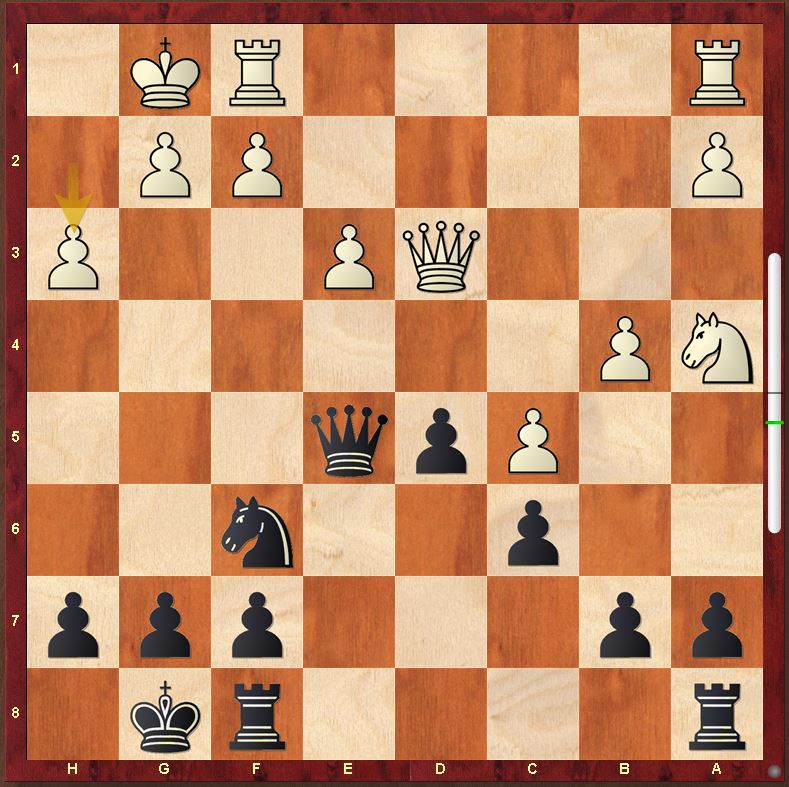
After losing a blitz game to a kid who also visits Siglap South CC Chess Club, I joined the endgame league series initiated by Mr John Wong. Fatefully, I was paired with his (younger sis), and both of us won with the White pieces from the following position. I got to say, I prefer her first move to mine, though I guess I managed to trick her somehow. 

First Endgame Position in Endgame League: White to move and try to Grind. Black to try and hold. 
(Players will swap sides trying to attack / defend the position.) In my first round, both my young opponent and I won with the White pieces.

Below was our attempt. I admit I feel that her choice of the first move with the White pieces felt  more forceful than mine. 


Personal Thoughts and Learning Points:
  • This is a good introduction to the Thomson CC Chess Club for learning. Honestly, even if the position is not winnable with objective best play from both sides, one needs to experience and learn how to play it out, how to try "grinding" as White and resist grinding as Black. While I'm disappointed that I failed to hold the position when playing Black, I hope I will learn the key things I ought to know, when the 'solution' is shared over next or next next week. 
  • Playing the position out is really important for learning and improvement (rather than offering / accepting draws every time, essentially giving up trying).
  • My endgame is bad, so I look forward to gaining more learning and experience in the subsequent game positions to come =) 
Happenings at Cashew Chess Club
While the endgame chess league was going on at Thomson CC Chess Club, the featured (90+30) game between Weng Chew and William took place at Cashew Chess Club.

The games (can compare my own attempt looking through the game, against Chessbase 15's "objective" tactical analysis) here:
http://view.chessbase.com/cbreader/2019/1/19/Game4538562.html

Personal Thoughts and Learning Points:
  • The opening phase of the game felt very sharp. I really didn't see 9.Qb1 (my bad). If anything, I definitely want to stay away from this type of opening / position in my own games =)
  • If Black wasn't seeing ghosts, the game could've ended as early as move 15 after 15...Bxg2. Opening play does matter -- the game can end that early. 
  • Endgames =) 
  • Towards the last part of the game, it felt like Black was trying to win at all cost. Even though Black failed, I feel that the effort and attitude is commendable. At the very least, this unsuccessful try teaches the lesson to not take excessive risks at times. It may also say a couple of things on the players' psychology -- ideal state of mind should probably be something like "staying as objective as possible, with no self-imposed obligations to win a game". Smart players should take a step further and always seek opportunities to place the "burden of proof" on their opponents for a psychological edge (e.g. If there is no way I can lose or become worse off in an arising position. I will just keep on playing, decline any offer of a draw and place the burden of proof on my opponent that he/she can play the position out correctly). 
These are just the newbie views of newbie_learner, so please take it with a pinch of salt. If you have any ideas or tips on how I can improve, please feel free to share!

Thanks again in advance, as always!


Yours sincerely
Ong Yujing (Eugene)
a.k.a. newbie_learner
Siglap South CC Chess Quartet

Sunday, January 13, 2019

Good Games at Siglap South CC Chess Club

Played a couple of good games at Siglap South CC Chess Club. Specifically, I got outplayed in 2 of the 3 games played at one point. Bad form on me in that I missed quite a bit of tactical things. But more importantly, I'm glad to see the progress of the kids.

To maximise learning value for everyone, esp. the kids, I'd try to share more tips as we go along. Of course, I will always qualify that I'm not an accredited trainer, and that everyone should always question what they are being taught/told.

(In chronological order)

Game 1


  • Overall, a "smooth" game. This particular line is something I play on both sides on a rather regular basis. I'm glad I remembered what I'd seen before -- 7.h3, as non-contributing to own development as it is, is a good move because it takes away the important g4 square away from Black's pieces and more importantly, allows the dark square Bishop to retreat to h2 should it be harassed by ...Nh5. 
  • I love my decision of 13.Qb3, offering to get my own pawns on the queenside wrecked for dynamic play, as well as the subsequent follow through while stifling Black to death.

Game 2


  • Bad on me to keep missing the tactical opportunities: 7...dxc4 and 9...dxc4
  • I really don't know how to generate play on the Queenside. Even though it is objectively not so good, I would really consider an early ...a6 to stop White from playing b4-b5 for good. Conceding the b6 square the White Knight is really not that big a deal (from Black's perspective).
  • More importantly, for long-term learning, I need to learn to appreciate how to play in this type of position.
  • White was completely winning at one point -- he should not have played at blitz rate just because Black is very low on time (living on incremental). Instead, White should slow things down while maintaining high quality moves.
White just played 17.h3 to take away the major threat of ...Ng4. The best move recommended is 17...Ne4, centralising, provoking weaknesses if White chases either the Black Knight or Queen. If White ignores it, Black can also consider consolidation with ...f7-f5.


Game 3


  • I forgot my opening analysis on Black's side =(  The best move after 10.Qxf3 is really 10...Qe7+. Because Black has the Isolated Queen Pawn, Black must really make the dynamic factors count. Every inconvenience that can be inflicted should be done! Even better if Black can inflict some damage on White's pawn structure along the way. 
  • Things could've been simpler with a prophylactic 11...h6 first, avoiding the Bg5 pin altogether.
  • Again, my judgement in this game is a little proof that I'm really not obsessed with the Bishop pair. After 12...Qb6!? I would have gone for 13.Bxf6 as White and inflicted further damage on Black's pawn formation, even though it costs White the Bishop pair.
After 12...Qb6!? I feel that the position is calling for 13.Bxf6 to be played.

  • Already not in good form today, but being low on time made the situation worse. One can never expect to play half as good as normal circumstances under time pressure.
I also played a mini blitz series with another adult chess player. On hindsight, we should've played on my DGT board instead, LOL.

Am curious to see how both these kiddos and other adult players including myself seek to improve with time! Caissa, please watch over us!


Yours sincerely
Ong Yujing (Eugene)
a.k.a. newbie_learner
Siglap South CC Chess Quartet
Saturday, January 12, 2019

Road to Arbiterhood for Chess Goddess Caissa!

(I think) this post may be of some use for:
  • newer chess players (or returning players) who do not know the current FIDE laws of chess very well;
  • experienced players who think they know the current FIDE laws of chess well (but may be surprised or even embarrassed to realise what they thought was correct, or have been doing in tournaments, is actually wrong) -- not blaming anyone, as some of the laws or the execution may not seem intuitive at first;
  • chess players or enthusiasts like myself who are interested in trivial things in chess (such as interpretation and application of the laws of chess, especially for unusual instances);
  • anyone who may find my article entertaining (even if it's laughable to you, I'm glad it served an entertainment purpose!)

Some Qualifiers Before We Begin
  • Some of the contents are not the final word on the matter -- if I am that good, I won't be needing to sign up for the upcoming FIDE Arbiter's Seminar organised by the Singapore Chess Federation ^o^ 
  • I will try to minimise my subjective opinion and focus on "what is correct based on the Laws of Chess" rather than "what I feel is a gentlemanly way to play a chess game". I have written on the latter before and have decided to remove my post. Will consider revising the topic on proper chess etiquette in chess should I feel comfortable / knowledgeable enough to share my views one day.

Why the Interest
Because I can see the value in contributing to the local chess community as an arbiter (or equipped with adequate knowledge to offer concrete tips and advice whenever the situation calls for it -- e.g. when a new player is playing his/her maiden tournament, when there are actual disputes in a game, even in a casual setting). 

I don't think I will ever get the norms required to become an arbiter (to do so means I have to sacrifice playing in the few local standard tournaments available, which I have no intention to stop playing at present), but if there are tournaments which I can volunteer in to gain practical experience, I won't mind. Also, if my own chess club @ Siglap South CC wants to organise any mini tournaments, I guess I can help.

My Reference Documents
I take feedback very seriously. One of the very beneficial feedback I received was the need for credible source. Currently, this is the best I found: FIDE Laws of Chess 2018 with comments by British Chess Arbiters’ Association. I feel that I gained a lot of insights from it, even thought there are minor comments which I personally do not fully agree with. Anyway, it is good to have a different view, if we simply accept everything we see, there's not much learning value / critical thinking I feel.

Laws Which I Feel Newbies in Chess Need to Know... and Why

  • 4.2.1 Only the player having the move may adjust one or more pieces on their squares, provided that he first expresses his intention (for example by saying “j’adoube” or “I adjust”).

    6.2.5 Only the player whose clock is running is allowed to adjust the pieces.


    This is important to know that you only need to say adjust once, because too many kids (and even a few adults) say "adjust, adjust..." for each adjustment they make on the same move, which can be quite irritating -- and disturbing the opponent is not allowed!

    Also worth noting is that you can only adjust pieces when you are having the move. 2 articles point this out! You are not supposed to adjust when it is your opponent's move. But based on my 3-year local tournament experience so far, "everyone" violates this requirement. Although it is debatable how serious this infringement actually is.

    The one situation which I feel in need of clarification (how players should react, how arbiters should facilitate) is, what happens when a player puts a piece cutting across 2 squares and pressed the clock? At present, I think the player who put the piece cutting across 2 squares ought to be penalised, but it would be a bit disruptive to do the corrective measures when time increment is concerned. This is 1 of the queries I intend to raise at the Arbiter's Seminar!

  • 6.11.2  A player may stop the chess clock only in order to seek the arbiter’s assistance, for example when promotion has taken place and the piece required is not available.

    6.11.4  If a player stops the chessclock in order to seek the arbiter’s assistance, the arbiter shall determine whether the player had any valid reason for doing so. If the player had no valid reason for stopping the chessclock, the player shall be penalised in accordance with Article 12.9.
    It is important to know that you can always seek the arbiter's assistance (by pausing the clock). Don't need to argue with your opponent and create a scene! Just note that if you do not have valid reason to do so, you can be penalised for disrupting the normal flow of the game.

  • 4.3 Except as provided in Article 4.2, if the player having the move touches on the chessboard, with the intention of moving or capturing:
    4.3.1 one or more of his own pieces, he must move the first piece touched that can be moved

    4.4  If a player having the move:
    4.4.1  touches his king and a rook he must castle on that side if it is legal to do so
    4.4.2  deliberately touches a rook and then his king he is not allowed to castle on that side on that move and the situation shall be governed by Article 4.3.1


    In layman's language, to perform a castling move, you need to touch your King first. If you touch your Rook first, it will be treated as if you intend to move the Rook rather than you intend to castle.  

  • 9.1.2.1  A player wishing to offer a draw shall do so after having made a move on the chessboard and before pressing his clock. An offer at any other time during play is still valid but Article 11.5 must be considered. No conditions can be attached to the offer. In both cases the offer cannot be withdrawn and remains valid until the opponent accepts it, rejects it orally, rejects it by touching a piece with the intention of moving or capturing it, or the game is concluded in some other way.

    9.1.2.2  The offer of a draw shall be noted by each player on his scoresheet with the symbol (=).


    11.5  It is forbidden to distract or annoy the opponent in any manner whatsoever. This includes unreasonable claims, unreasonable offers of a draw or the introduction of a source of noise into the playing area.

    What is important is how 9.1.2.1 is interpreted. If your opponent offers a draw without moving, you are entitled to request to see the move to decide whether to accept the draw offer or not. The draw offer stands.

    I still remember this incident a couple of years ago, when my opponent offered a draw without moving, I asked her to "show me your move", which she interpreted it as me rejecting her draw offer orally. Even though the arbiters ruled it in my favour (that I can still accept the draw offer), I learned the importance of making your intention clear. I have explained my request very clearly these days. "I am considering your (draw) offer, and would like to see your move to decide." I don't think anyone wants to always be surrounded by controversy, do they? =)

    It is not allowed to make unreasonable offers of a draw to distract or annoy the opponent. Since it comes with the plural "s", I would take it that it is permissible under the laws of chess to make 1 single insincere / annoying draw offer. Whether to do it or not (etiquette consideration beyond the coverage under laws of chess) is up to the player's own choice.

    Last but not least, it is good to record each and every draw offer (=) in case of a claim/dispute.


  • 6.2.3  A player must press his clock with the same hand with which he made his move. It is forbidden for a player to keep his finger on the clock or to ‘hover’ over it.

    7.5.1  An illegal move is completed once the player has pressed his clock. If during a game it is found that an illegal move has been completed, the position immediately before the irregularity shall be reinstated. If the position immediately before the irregularity cannot be determined. the game shall continue from the last identifiable position prior to the irregularity. Articles 4.3 and 4.7 apply to the move replacing the illegal move. The game shall then continue from this reinstated position

    7.5.2  If the player has moved a pawn to the furthest distant rank, pressed the clock, but not replaced the pawn with a new piece, the move is illegal. The pawn shall be replaced by a queen of the same colour as the pawn.

    7.5.3  If the player presses the clock without making a move, it shall be considered and penalized as if an illegal move.

    7.5.4  If a player uses two hands to make a single move (for example in case of castling, capturing or promotion) and pressed the clock, it shall be considered and penalized as if an illegal move.

    7.5.5  After the action taken under Article 7.5.1, 7.5.2, 7.5.3 or 7.5.4 for the first completed illegal move by a player, the arbiter shall give two minutes extra time to his opponent; for the second completed illegal move by the same player the arbiter shall declare the game lost by this player. However, the game is drawn if the position is such that the opponent cannot checkmate the player’s king by any possible series of legal moves.


    In layman's language, an illegal move (often involving but not limited to not addressing a King in check, or capturing opponent's King, not replacing the promoted pawn with a new piece) now includes pressing the clock without making a move, as well as using 2 hands to make a single move.

    If you made an illegal move but you have not pressed the clock, you are allowed to undo it while observing "touch move" (in article 4). This includes the realisation that you were using 2 hands to make a single move. You can undo the move made using 2 hands and now use 1 hand to handle the single move without incurring any penalty (other than spending the additional time taken to make this correction).

    Something of interest (more to the arbiters rather than the players) is that moving and pressing the clock with different hands is not an illegal move, but an illegal action.
  • 9.2.1  The game is drawn, upon a correct claim by a player having the move, when the same position for at least the third time (not necessarily by a repetition of moves):

    9.2.1.1  is about to appear, if he first writes his move, which cannot be changed, on his scoresheet and declares to the arbiter his intention to make this move

    9.3  The game is drawn, upon a correct claim by a player having the move, if:

    9.3.1  he writes his move, which cannot be changed, on his scoresheet and declares to the arbiter his intention to make this move which will result in the last 50 moves by each player having been made without the movement of any pawn and without any capture

    Under normal circumstances, we always make a move before we record our moves on the scoresheet. However, if we are claiming a draw whereby our move to be made will result in the same position arising for at least the 3rd time, or the 50th move by both players with neither any pawn movement or any capture, the correct way to claim it is to write the move you intend to make on the scoresheet (without making the move on the board), and declaring the intention to the arbiter.

    The reason, I believe, is that if you made the move over the board, the opponent can claim that you were actually making the move (and not intending to claim a draw). 
  • 5.2.2  The game is drawn when a position has arisen in which neither player can checkmate the opponent’s king with any series of legal moves. The game is said to end in a ‘dead position’. This immediately ends the game, provided that the move producing the position Was in accordance with Article 3 and Articles 4.2 — 4.7.

    6.9  Except where one of Articles 5.1.1, 5.1.2, 5.2.1, 5.2.2, 5.2.3 applies, if a player does not complete the prescribed number of moves in the allotted time, the game is lost by that player. However, the game is drawn if the position is such that the opponent cannot checkmate the player’s king by any possible series of legal moves.
    This is quite an important law to know. The reason I put this as the last article to highlight is that I am going to rant on this quite a bit.

    First, there is NO PROVISION to claim a draw under circumstances such as a) theoretical drawn positions; b) player with superior position but lower on time claim a draw. I was genuinely surprised that some (not just 1) of my chess friends made up their own ideas (probably based on their recollections of older versions of the FIDE laws of chess), that the player with a superior position can always claim a draw before his flag falls.  (Unless we are talking about Quickplay Finishes rule apply, which is extremely rare, if not non-existent in tournaments today.) I only hope my friends will actually read the revised versions of the laws on their own, and not risk spreading wrong information to the unknowing ones (who don't bother to read the Laws of Chess on their own to verify the correctness of what they hear).

    To put it in layman's language, if your flag falls, you are almost certainly "screwed". As long as there is any series of legal moves (not necessarily "logical" or "reasonable") for you to be checkmated, you will be deemed to have lost the game. And no, you cannot claim a draw just because you have a superior position. If I am mistaken on this, please let me know -- show me which article in the current FIDE laws of chess allowing such a claim.

    Second, this is probably not a problem under formats with time increments. Since players may not wish to extend the game with unnecessary moves (moving the pieces back and forth). But this may can an issue for a) formats with no time increments, and b) blitz games. I can't express enough my dislike hatred towards formats with no time increments, where the result of some games can arise from mindless pushing of pieces to claim a win on time.

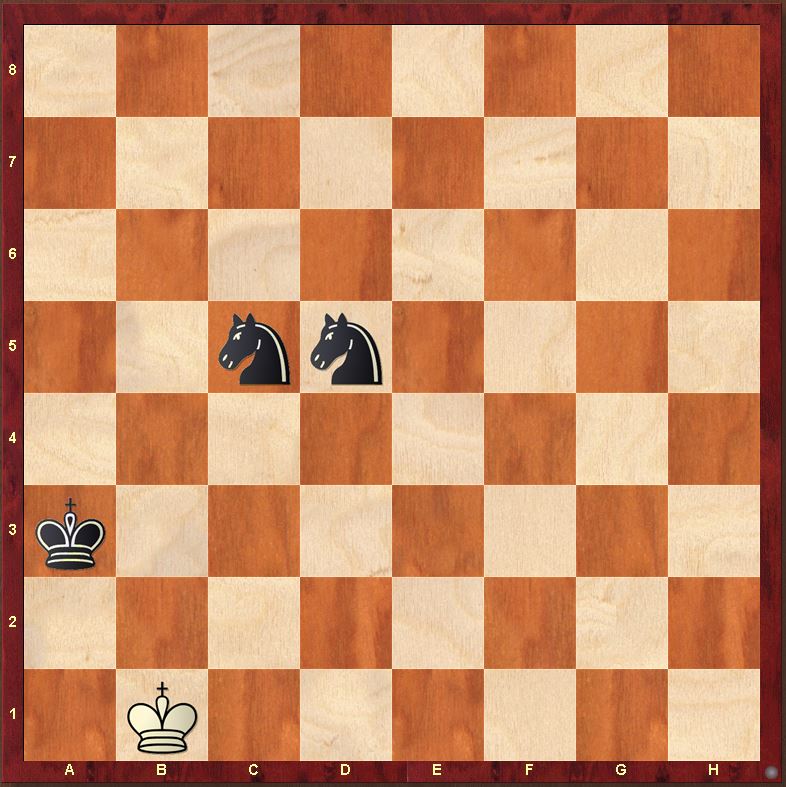
    Using the simplest example, in a Lone Rook v.s. Lone Knight endgame, the superior side (with the Rook) would be deemed to have lost the game if his flag drops, because the following checkmate position is possible through a series of legal moves:

Black to move, Black delivers checkmate with 1...Nc2#. 

  • Of course, "sensible" players would probably agree to a draw. But as players, the point of learning the laws of chess is to protect ourselves -- opponents are not obliged to live to our expectations and accept our draw offer, and to be fair, opponent is doing everything permissible (declining a draw offer) by the laws of chess to try to win. To address this situation, I would suggest that under non-incremental formats, if the superior side (with lone Rook) sees that the inferior side shows that he/she knows how to defend the position, and we are coming down to say the last 1-2 minutes, rather than risking to lose by time forfeit and continuing the grinding, initiate Rook takes Knight, or throw a Rook check beside the opponent's King -- once the Rook is captured, a dead position arises for a draw.

    Draw positions like lone Rook v.s. lone Rook, lone Knight v.s. lone Knight is not "automatically" drawn based on the current FIDE Laws of Chess, and will be a real problem under formats with no increments (esp. when 1 side is severely low on time). Hence I hope that most, if not all tournaments will start adopting formats with increments and stop using formats with no increments! In the FIDE Arbiter's Seminar to come, I will clarify if my understanding is correct. Really awkward to know that 2 Knights v.s. lone King will be ruled as a win for the side with 2 Knights... you get what I mean.
Self help mate can be delivered after 1...Nc3+ 2.Ka1?? 2.Nb3#. This is how it would be ruled should White's flag falls.

There are actually a lot more interesting situations and scenarios whereby there are some important interpretations or understanding required to "rule" correctly. I will probably share more knowledge and insights gained after going through the FIDE Arbiter's Seminar (to minimise the spread of wrong knowledge). Wish me luck!


Yours sincerely
Ong Yujing (Eugene)
a.k.a. newbie_learner
Siglap South CC Chess Quartet

Friday, January 11, 2019

Good Chess Night at Thomson CC Chess Club

Was glad to see my chess friends and some new chess kids. But nothing can compare to this game with a kiddo who used to play at Siglap South CC Chess Club. To be honest, today was not the best play I can offer because of my lack of sleep for the past whole week. But I usually don't know how to reject any request for a game ^o^ And once we step onto the chess board, there are no more excuse!

Quite frankly, I found the kid familiar, but I didn't recognise him until after the game was over. But I feel that he has improved so much since we played months ago. I understand that he hasn't gotten a coach, but has been playing many online games on his own. Well, whatever works for you best, keep it going!

newbie_learner v.s. kiddo

Feelings and Learning Points

Because I'm not in very good state of mind, I have also made available "one-click analysis" from Chessbase 15 (using stockfish 10) to pick up tactical mistakes and inaccuracies for comparison against my analysis for the game. The games can be opened up here:

http://view.chessbase.com/cbreader/2019/1/12/Game158973640.html
  • 3.Nc3 is one of the anti- King's Indian Defences which I have recently experimented with great success. I was surprised that so many opponents did not play 3...d5 which is the main move to take away White's e4. After 3...d5, Black makes it very difficult for White to achieve c4 or e4 to make a pawn duo with the d4 pawn. Of course, these days I also have other sidelines, and I also play into the mainline too -- I feel that I shouldn't always run away from my fears. Rather I should face and overcome it.
To any reader who might need a side-line to face the King's Indian Defence, would you like to try 3.Nc3 ? Hopefully Black doesn't play 3...d5 =) But even if Black does, it's not necessarily the end of the world. "Just play chess" if that happens!

  • Before this game, I was just telling another kiddo I played with, to not show too much emotions when he felt he just made a bad move, giving opponent free clues. I hope I didn't show too much frustration on my face when I played 15.g4?! The most annoying thing is, that I knew exactly what was coming (15...Ng3) and I even had all the ideas to fight it. Yet I allowed it due to a complete loss of focus on my part. 
I can't really explain how I can make the blunder of 15.g4?! when I already identified that Black was playing 15...Ng3, and I was even thinking of responses to either prevent Black's Knight from coming in, or to avoid losing the Bishop pair. 15.g4?! must be 1 of the worst mistakes possible in this position.

  • 19.Qb5 was really timid on my part. Again, whenever I'm on panic mode, I tend to over-simplify the position because I value simplicity and equality under such circumstances. This may also be partly attributed to my mental state -- I feel tired and didn't want to get into a highly complicated position and "overwork" myself.
My objectively sub-par move 19.Qb5 to simplify the position by forcing an exchange of Queens.

  • I still have a lot to work on appreciating pawn breaks and "positional chess". After Black's 21...h5, which looks like a fine move, what would you play? I played 22.Rdh1, but if Black doesn't play ...hxg4, what does White actually do from there?
Care to suggest how White should continue from this position after Black's logical-looking 21...h5 ?

  • Enough of the criticisms. Some good stuff: I was super lucky to be able to convert this rather equal position. Yes, I admit I am super lucky, though I also feel that I worked hard enough for luck to work for me. I don't know if I'm making sense here.
Position after 32...Nb8. With nothing to lose, I tried 33.Ba5+ Kb7 (33...Kc8 is worth considering as it seems to avoid any tactical complications) 34.Bd8 This was essentially a tricky move to lure Black into making a mistake. I do want to share my view, that this (playing moves which stays on equality if opponent makes the correct move, and wins if opponent replies wrongly) is not "hope chess". Rather, I call this a "free shot", since this feels like a free shot to try and win a game. After all, if your opponent does not make a since mistake, you cannot win a game! Here, it was unfortunate for my opponent to play 34...g5?! when Just moving the dark square Bishop away should maintain equality. I guess Chess Goddess, Caissa, blessed me again for being a faithful follower! 

The night ended great with a post-birthday celebration supper treat from Mr John Wong -- thanks again!

And thank you for reading, once again!


Yours sincerely
Ong Yujing (Eugene)
a.k.a. newbie_learner
Siglap South CC Chess Quartet

Thursday, January 10, 2019

Birthday Chess Game Review

They say that Birthday is a chess player's curse, so instead of risk playing a game of my own, I decided to take some time to review a game played between 2 of my chess friends ^O^

The game was composed at Singapore Chess Meetup yesterday, between William, part of the Siglap South CC Chess Quartet (other members being Seng Chin, Eric and yours truly), and Weng Chew, a long-time local chess enthusiast and facilitator of Cashew Chess Club and the Senja-Cashew Chess Club.

To give some context, Weng Chew has won all past encounters until recently, when both William and Weng Chew each won once with the White pieces. To be honest, Seng Chin and I have been giving lots of ideas and motivational talks on how William should play the game and match-up. (This is team effort in a solo-played chess at work!) In fact, I feel like I learned a lot from the discussions. In particular, because I see myself as quite a "booked-up" player (with no offence intended, I see myself quite similar to Weng Chew in this aspect), I am really curious to see how the matchup would go. William is complete opposite -- he enjoys playing sidelines, and quite honestly, I have not encountered a single player who plays like that in the local standard tournaments I played for the past 3 years. It should not come as a surprise that William has not played a maiden tourney yet ^o^

And I do have quite a bit to say about this game while reflecting on my own current play. Without further ado, here goes. In addition, I need to qualify that I am a learning player myself, so take my views with a pinch of salt, and I would be most grateful if fellow chess enthusiasts and friends can correct me where I'm wrong.

The Game Itself


Personal Views and Learning Points

  • It is really important to stay flexible where possible. What I mean in particular is that if a non-development move is designed to counter a particular setup, it may be preferable to play other development moves at your disposal first. 

newbie_learner's opinion: 3...a6 is not in line with the General Opening Principles (Develop, Centre Control, King Safety). My guess why Black played this, is that he wants to fight the Queen's Gambit type of position with ...dxc4, and after White recaptures with Bxc4, play ...b5 to kick the White Bishop on c4 to gain time for ...Bb7 to develop Black's light square Bishop on the a8-h1 diagonal). But if White does not play c4, what does this move actually achieve? It's probably safer to consider something like 3...Nf6, "mirroring" White while retaining some options. 
  • I actually like this Colle-Zukertort system quite a bit (consistent with my first impressions)! It does seem rather flexible. And I already foresee some opportunities to stay flexible while adjusting the move order a little. I guess it will do me good to have more side-line options in my arsenal. Also, I do look forward to more training games trying to play this opening on both sides -- I honestly have not encountered this in the tournaments I played, and I want to farm more experience on both sides!
  • I would be lying if I fully understood the game positions arising throughout (my annotations are heavily assisted by the engine). What is important, which I failed to understand on my own, is that after 13...Nh5 (which the Knight doesn't seem to be threatening anything by itself - but it could be to allow for ...f6 or ...f5), the engine deemed 14.Rd1! to be the best. I can understand the desire to bring a "sleeping" piece into action, but I did not expect d-file to be the one that is going to be opened up.

How much study do I need to come to understand that the best move in this position is 14.Rd1 ?

  • I missed a lot of tactical factors which White could've adopted to win earlier. Another problem I have, is identifying the pawn breaks. I need to come to terms that sometimes, it is more than okay to damage my own pawn structure for a much greater good. Otherwise, I will keep missing out chances to press/win positions. 
Overall, I enjoyed myself reviewing this game. Also, I was surprised to come across this interesting collection of games. I don't know that many chess masters, but I am surprised to identify a couple of familiar names! In case anyone else is also interested in this opening, check this out:


Your feedback would be my best birthday gift! Thank you!


Yours sincerely
Ong Yujing (Eugene)
a.k.a. newbie_learner
Siglap South CC Chess Quartet
Sunday, January 6, 2019

Interesting Games at Siglap South CC Chess Club 6 Jan 2019

I'm not the type who is particularly sentimental over the "new year". Still, in this first chess session of year 2019, I suddenly feel the desire for our chess sessions to be as beneficial for all participants as far as possible. So I will be more proactive in giving basic tips to my opponents, as well as probing them for tips (esp. in the games I got outplayed)!

Of course, we have to maintain balance and respect wishes of players who just "wanna have a good time". But I would make it a conscious effort to help younger players, esp. kids I encounter, since many of them show eagerness to learn and improve in their play (some are also registered with the Singapore Chess Federation for various training and theory classes. Things like recording your games would be good for review and learning.

Below are 3 of my games played today, with learning points from all of them. Again, do take my comments with a pinch of salt. I'm just a 1499 FIDE rated player who is seeking to learn at the same time.

Game 1: newbie_learner v.s. kiddo

Thoughts and Learning Points

  • I'm heartened to see the kiddo 'challenge' me to a 90 + 30 game. Most kids prefer to player faster time controls, which arguably have more limited learning value. Unfortunately, I can't oblige as we may not be able to finish  even game from 3-6pm. Hence, as the best alternative, I introduced QCD Adult Chess League's format of 30 + 30 (the fastest standard chess). 
  • I thought some of the in-game comments would be beneficial for newbies and learners just like myself. For instance, it would have been great if my opponent actually plotted the "fake gambit" which I took the bait. It would also be great if he could've refuted my play winning the pawn while compromising the position. 
  • In terms of choosing candidate moves, I hope some of my thoughts on my own decision making highlights some dilemma we face. For instance, both 9.c4 (challenge / weaken Black's pawn centre) and 9.e3 (support White's d4 pawn to deny Black from liberating the position easily with ...e5) are comparable, there's no need to spend too much time at the cost of compromising the thinking time remaining. Overall, I think the time management of this game was decent: White ended the game with 18 minutes and Black with 8 minutes.
  • Another learning point was the demonstration of choosing between candidate moves at move 24. White chose the ordinary looking 24.Rfd1 to double Rooks instead of 24.Rxd8 Qxc2 25.Rxe8+ Bf8 which White felt was inadequate. While White deserves A for effort to at least bother to choose between the 2 candidate moves, unfortunately, White did not calculate enough to address the key issue: how to effectively double White's Rooks in the variation he rejected. To learn from this and hopefully improve in calculations (most importantly, don't be lazy and take the effort to calculate deeper!) would be something that newbie_learner would like to learn!
Position after 23...Qf5. A for newbie_learner's effort, but still not quite there yet.

  • The position after 24...Rxd3 is also of interest for learning, in that White decided to play 25.Rxd3 instead of allowing for more exchanges following 25.Qxd3 Qxd3 26.Rxd3, whereby I'm uncertain whether the 1 pawn advantage is adequate for White to convert the position (Rook and Bishop of Opposite colour). This happens to steer away from the general principle: "When you are ahead in material advantage, exchange more pieces." If I followed this guideline (blindly), I fear I would reach a point whereby converting the advantage to a win becomes very difficult if not impossible. I guess it also says a little bit of the players mindset -- White is trying to maximise his winning chances. (chess psychology). 
  • Of course, 26...b5?! from my opponent was unnecessary. Cannot play such obvious "baits" in a long game (Opponent was hoping for 27.Qxc5 Qxd3). I hope my kiddo opponent will learn from this and improve his future play. 


Game 2: Young Adult v.s. newbie_learner

Thoughts and Learning Points
  • Again, in terms of choosing candidate moves, this time round Black abandoned the thematic idea of "Bringing out the light square Bishop before chaining the pawns with ...e6" because he saw that 6...Bg4 would fail. Yet he forgot to check another candidate move fulfilling the theme: 6...Bf5. He dropped this idea "feeling" that after 7.0-0 Black's light squared Bishop seems to be hanging, without bothering to calculate 7...e6. This highlights my current problem: lack of calculation, and allowing "feeling" to take over basic calculations. 
6...e6 which was played, really cannot be compared to 6...Bf5 followed by ...e6
  • Black lost objectivity when the position looked promising. Need to learn to stay calm. Having worked so hard to get a promising position, it hurts to spoil it so easily!
  • Very poor time management from Black, surviving on incremental towards the end. Will never be able to play consistently well under time pressure (human tendency). Also, my opponent never fall into the trap of playing faster to "flag me". Instead my opponent took his time to improve the quality of his moves more and more. 


Game 3: newbie_learner v.s. Young Adult

Thoughts and Learning Points

  • I had my "revenge", LOL. Nah, it is good that the games did not go too one-sided. It can be rather demoralising at times, I understand. More importantly, as you better figure out your regular opponent's playing style, it should spur both to play even better in future games. For this opponent, he plays quite a wide variety of openings, so he was able to transpose here and there while keeping his options open. (This was evident in a subsequent mini series of Blitz games we played, with around 50% results on both sides.) I was prepared to see the Benko Gambit, but it became a King's Indian Defence (KID) "all of a sudden". But I'm glad I registered another win against my #1 hated opening, lol
  • I know that White is spending ALOT of moves on this, but I really liked the idea of preparing for 9.Bh6 to trade off Black's thematically powerful fianchetto Bishop on g7. Based on this game, I actually feel that even without h-file open, this idea of trading off Black's fianchetto Bishop as early as possible is still decent. 
If you are playing White, would you be spending so many moves like I did just to trade off Black's fianchetto Bishop on g7, even though you are not having the h-file open? Do you opine this to be more beneficial for White or Black?


Other / Final Thoughts and Experiences
  • Grats to William for also winning his for the first time against Seng Chin. This unrated player with no tourney experience has been on hot form this week! We fellow Siglap South CC Chess Quarter players are happy for you!
  • The "Young Adult" has been introduced to the QCD Adults Team Chess League. So far, there are 3 players I would be helping to source for a team. I just hope I can find them all in a suitable team.
  • Just a happy shout-out to 2 other chess sites which also had a great session today:
    PubXChess a record high 21(!!) player blitz tournament was held; and
    Nanyang CC Chess Club -- Happy to see many new and familiar faces. Maybe we should try to organise some tournament between these 2 Chess Clubs one day! 
That's all for now. Time to face the music in office... Will be 'dead' for a few days before my next chess resurrection (Hopefully, I can make it for Singapore Chess Meetup on this coming Wednesday!) 


Yours sincerely
Ong Yujing (Eugene)
a.k.a. newbie_learner
Siglap South CC Chess Quartet

Saturday, January 5, 2019

Interesting Games and Self-Reflection on 4 Jan 2018

Quite a lot of small interesting episodes on a short night of chess

  • A kiddo whom I played with at Thomson Chess Club played a simple, rarely played (according to database) yet seemingly practical move against me in 1 of my frequently played opening lines. I do not claim to know the best /reasonable response yet. Would be grateful if anyone who has some experience can offer me some tips.
  • William, one of the Siglap South CC Chess Quartet, has finally won against Weng Chew (Weng Chew won all previous games)
  • Have received some honest feedback and criticisms about my play, and I will be responding to them honestly =)
Some of these would be inter-twined. A new writing style I'm trying out. I just hope readers won't be too "lost".
Thoughts after the Game
  • It's not necessarily worth it to avoid mainstream lines for the sake of avoiding mainstream lines. I can't justify the position for White after 1.c4 c6 2.d3 d5 3.cxd5 cxd5 -- if anything, I feel Black has at least completely equalised.
  • I got bluffed not accepting the gift Knight 12.Ng5+ and responded with a "turtle"-like 12..Kg8. I should have been more careful. 
  • Otherwise, I like the remaining of my play. Just accept all the sacrifices! The onus is on the side having made the sacrifice to make the attack work. 


Thoughts after the Game + Response to Criticism

  • Response to Criticism: "newbie_learner always wants to keep the Bishop pair". Absolutely untrue. My critic has presumably never seen these Caro Kann games I played as Black. I always offer the Bishop pair right from the start in this 2 Knights variation =) Also, everyone "knows" that Bishop pair is advantageous, especially in open positions. There is nothing wrong to formulate an entire opening approach based on seizing the Bishop pair, because it's that good! (There are even certain lines in openings like the Caro Kann Defence: Exchange variation, which is almost fully designed to play just against Black's light squared Bishop.)

    I think how this criticism came about is my critic was looking through a game I lost which started of with me fully engaged in this "Bishop pair hunting" right from the start. Actually, that whole strategy of Bishop hunting in that game was supported by engine's evaluation. I lost the game because of my poor continuation, not because of the part on my Bishop hunting. This (attributing losses to the correct aspects) is something I value a lot. Otherwise, I would just keep changing the way I play (keep changing whenever I lose) without actually learning anything. So no, I do not agree with the criticism, in that I am not obsessed with the Bishop pair (for the wrong reasons). In fact, there are positions which I do not mind giving up the Bishop pair right from the start, such as this one.
  • Back to this specific game, what I hope to learn is how exactly does Black deal with this simple yet effectively irritating move of 6.Qg3? (1.e4 c6 2.Nf3 d5 3.Nc3 Bg4 4.h3 Bxf3 5.Qxf3 e6 6.Qg3) According to the free database I have access to, it is not played that often, but boy is it irritating! Specifically, I don't know what's the most effective way to allow me to continue to deploy my dark square Bishop on f8 effectively while the g7 pawn is being harassed by the White Queen. If anyone knows, please share with me!

For Advice: What Should Black Play to Develop Effectively?
  • 2 general guidelines which showed in this game were that exchanges are never innocent (it often benefits one party more than the other) and long term weaknesses. Regardless what the engine "says", I love my move 17...dxe4 which created permanent pawn weaknesses.
  • Response to Criticism: "newbie_learner always follows general principles to a T" Absolutely true. However, I'm not sure if this is doing me more good or more harm. On one hand, I feel that I don't make unforced blunder dropping pieces so easily but on the other hand, often I leave opponent's mistakes unpunished. Yet despite knowing all these general principles, I still have difficulties executing them correctly consistently in my own games (otherwise, I won't be a newbie) ^o^ But I do think that whatever the case is, tactical considerations should be given top priority most of the time, which admittedly, I neglect this from time to time. That's why I'm particularly vulnerable whenever opponent generates an attack against me, LOL.

The best is saved for the last. William went all the way to the Cashew Chess Club to play with Weng Chew and finally registered his first win. I got permission from both players to share this. But out of absolute respect (because I am not that good myself, I have concerns my "analysis" may be off, whereas I have no such obligations looking through my own games ^o^) I have done my review in quite a number of different ways, including separate one-click tactical analysis function of Chessbase 15 to look at it from a pure engine view. Interestingly, I don't fully agree with engine's suggestions! I guess the reader has to make his/her own judgement call at certain interesting moments of the game.


newbie_learner's analysis of William-Weng Chew

The Siglap South CC Chess Quartet has been trying our best to assure William that "it's all in the mind". If you start off the game not believing you can win, you never will. Everything was done right in the game (not that there's no room for improvement, but most things and decisions came out well).

Now that the doughnut was broken, all future games between this pair would be even more interesting I bet =)
I have also added a comparison analysis based on Chessbase 15's one-click tactical analysis. Open a new window from the link below:
http://view.chessbase.com/cbreader/2019/1/5/Game861860203.html

Thoughts after the Game + Response to Criticism
  • Black seems to have over-prepared and delayed ...c5 pawn break for too long, to the point that it allowed White to do a complete regroup. It really does seem easier for Black to play ...c5 as early as possible. 
  • The biggest learning point to me was the position arising after the move 14.Ne5. I know that not everyone agrees with me, but the way I see it, it is a very provocative move. Specifically, it will likely work against newbie like myself who follows guideline to a T: "Always fight off opponent's pieces in your turf as soon as you can." Following this guideline blindly would have picked 14...Nxe5 as the move to make. Only to face White's menacing pawn charge starting from 15.f4.  Actually, I'm still not sure how much better Black is, but the recommendations from the engines is to just trade off both the c and d pawns to minimally open up the scope of Black's Bishop pair. Because the Knight on e5 hasn't got very concrete targets yet.
  • Response to Criticism: "The way newbie plays can be summarised as this: Minimise the occurrence of weaknesses, but often seemingly without any true demonstration of the point behind it"
    It depends on how you see things. On one hand, I agree to a large extent. On the other, I feel that there are certain (even if few) concepts which I understand decently well. I'm just not sure which specific concept my critic feels I don't demonstrate correct understanding over. I think it is more accurate to describe myself this way:

    "As a newbie who is not very good with the fundamentals, especially the appreciation of imbalances which all newbies struggle against, newbie_learner's lazy approach is to minimise weaknesses at all cost. Where there are less weaknesses in the position, it is easier to keep things in order. However, it is true that newbie_learner also let the opponent off the hook a lot, because he does not appreciate imbalances well. This leads to lots of problems in his games. For instance, opponents who know this are often allowed to take 'free attacking shots' based on newbie's desire to avoid imbalances. newbie_learner even suspects this is why his records are so terrible when facing double-edged openings like the King's Indian Defence and the Benoni Defence. "
  • To improve, I do see a need for me to allow myself to play in more dynamic positions with imbalances. Minimally, it will give me more opportunities to test and improve my evaluation of positions. Shall make this a chess resolution for this year. Thanks for all the criticisms above!
Looking forward to hearing more feedback. Thanks again for your time!


Yours sincerely
Ong Yujing (Eugene)
a.k.a. newbie_learner
Siglap South CC Chess Quartet

Where to Play Chess in Singapore 2021 (COVID times)

It's probably been a year since I updated this chess blog. Due to the current global pandemic, over the board (OTB) chess has been so ba...