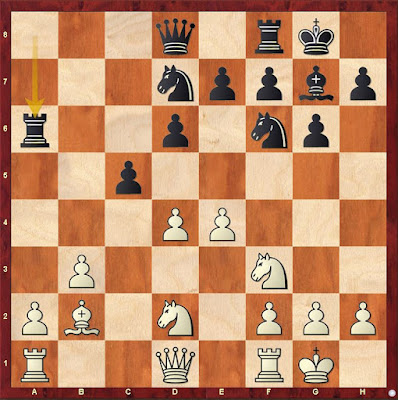
Both Kings felt safe enough to stay in the centre. After the game, I shared my views that I felt White would've been better to consider something like 17.Bd3 instead. After 17.Bb5, I thought 17...a6 was a great move, since it relieves my a8 Rook of its defensive duties while giving the White Bishop a Kick. I do not mind 18.Bxd7 Kxd7 since my d7 Knight was not doing much anyway.
19.Rhc1 Rac8
20.Rc3! f6!?
21.Rac1 Be4?! Diagram
I actually suggested quite a bit of improvements on both sides after the game ^o^ 20.Rc3 was smart on White's part to fix the pawn structure. I think I was confused with 21.Rac1 -- this exposes Black to White initiating the exchange of Rooks on c8 (even though White continues to "suffer" the double isolated pawn. Instead, I think Black should play 21...Rxc3 and let White decide whether to fix the pawn structure with 22.bxc3 or 22.Rxc3 to play with activity. Black should not be worried as the King on d7 has covered up the c6,c7 and c8 squares, so White Rook cannot penetrate on the c-file. Black can instead, go back to work on Kingside activity with say, ...f6 and only after then, ...Be4.
Engine: 20...f6 felt a bit shaky. To solve Black's problems, indeed 21...Rxc3 should be played. While this allows White to repair his pawn structure, at least Black won't be "tied down" due to the obligation to not exchange.
22.Ne1 fxe5
23.f3 Bf5!?
24.dxe5 Rhg8?! Diagram
These were my post-game thoughts: White could've just initiated double Rook take on take the Black King away from the center. Then White can decide how he wants to play out the Knight-v.s. Bishop endgame. Black was even more imprecise here -- I should've initiated Rxc3 while I still had the chance and only after then, decide on the deployment of the Black Rook and the Bishop on the Kingside. I think Black would be in trouble had White initiated double capture on c8 by virture of King position -- White King is far more centralised and superior.
Also, I think 23...Bg6 is better than 23...Bf5. I played 23...Bf5 to take away the possibility of White initiating g4. But the way Black did things was so slow! At least, after 23...Bg6, Black can do ...Rhf8 to work on the semi-open f-file. In any case, White really should consider initiating double capture on c8 to prove that Black is wasting time on Rh8-h7 (and de-centralise the Black King).
Engine: 23...Bf5 misses a tactical shot: 23...exd4! and after 24.Rxc8 Rxc8 25.Rxc8 Kxc6 26.fxe4 Bxe4 I wrongly evaluated that this is better for White because Black's King is far away. The central pawn mass (essentially, supported and connected pass pawns!) says otherwise! Never stop at general impressions -- calculate in big positions like this! I actually did freeze at this move (I took time to calculate), but I evaluated the arising position wrong.
Also, 24...Bf5 that was played, is much better than 23...Bg6 if White realises that he should exchange both Rooks and push the Black King back: 23...Bg6 24.Rxc8 Rxc8 25.Rxc8 Kxc8 29.dxe5. This is because eventually, Black would need to play ...g7-g6 to chain up with the pawn on h5. Hence, it would be a waste of time to move the Bishop away from g6 and then play ...g6.
25.Ke3 Rxc3
26.Rxc3 g5!?
27.hxg5 Rxg5 Diagram
Luckily, I think Black is finally proceeding in the right direction. The c-file which White Rook is looking at, is actually well-covered by Black -- the Black King on d7 took away the squares for White Rook to penetrate. On the other side of the Board, Black is actually making concrete progress with the Rook on g8. I believe the Rook on g8 must be stronger than the Rook on c3. On hindsight, perhaps White should consider taking the chance to repair the pawn structure, with 26.bxc3 instead. The Rook on c1 is well-positioned to relocate and contest on the other side of the Board / potential open files.
28.f4?! Rg4
29.b4 Be4
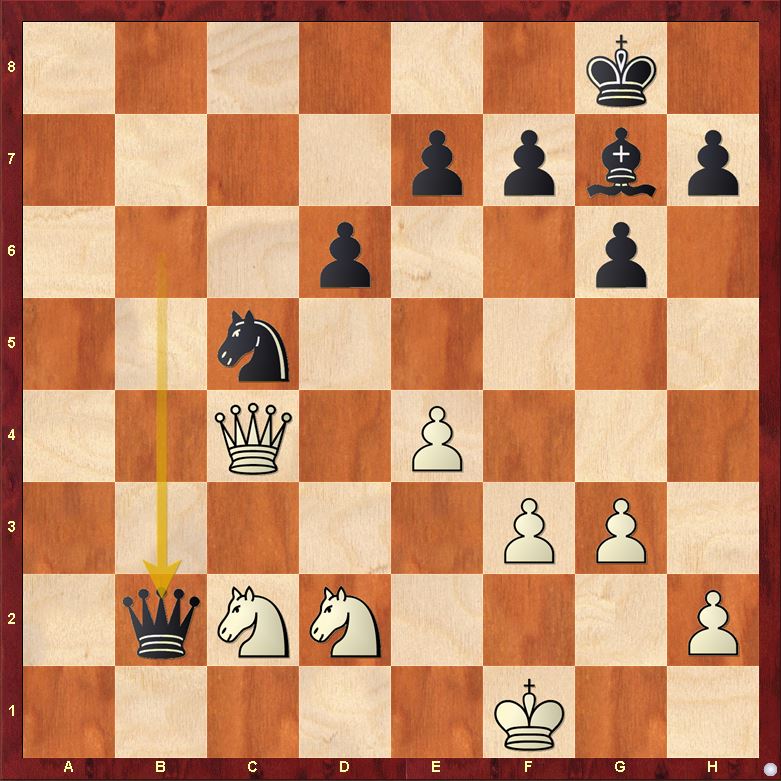
30.Nc2 Rxg2! Diagram
On hindsight, 29.f4 felt really unnecessary for White to me. Of course, I couldn't care too much about White's choices here, since I am very low on time. I love my find of 29...Be4 -- the White Knight on e1 is dominated, since every square it can go to is covered by the Black Bishop. After 30.Nc2 which effectively concedes at least a pawn, I know that Black probably has a winning position, but I spent so much time, I only made the move in dying seconds of the game (hence the !, not that the move 30...Rxg2 itself was anything special).
Engine: 28.f4 was indeed the critical blunder which lost the game for White. Interestingly, the best move recommended was 28.Kf4, giving the Black Rook a chase. Position after 28.Kf4 is evaluated as dead equal (0.00).
31.Nd4 Rxg3+
32.Kf2 Rg2+
33.Ke3 Rxb2
0-1
Final position of the game -- White has 25:38 remaining on his clock while Black has (only) 1:09. I guess one thing Blitz really helped me, is the courage to play when low on time. "nerves of steel" when playing under severe time trouble is something I wish to acquire.
Summary of Learning Points
1. Every game and position is unique. One should not be influenced by negative experience of the past (bad Queen placement) But in this game, 7...Qb6! would have secured a huge advantage within the opening phase).
2. Cut down on redundant moves -- 11...Qxb3, 14...Nf5, 24...Rhg8
3. "Do not initiate exchanges which benefit the opponent." is a wrong guideline to follow! The correct understanding should be, "Evaluate exchanges by first considering the outcome of initiating the exchange, followed by the outcome of opponent initiating the exchange, and choose one that makes it best for you / worst for your opponent." In this game, I attribute my bad decision to not initiate the Rook exchange on c3 (repairs White's pawn weakness) to not evaluating what happens when I wait for my opponent initiate the exchange. By "waiting", I end up getting my other Rook stuck and King stuck (as they had to prepare for the recapture on c8) and had White initiated the exchanges on c8, Black would be in trouble because the Black King will be kicked back to the backrank.
4. Black's miss after 23.f3 is a clear sign of lack of basic understanding of imbalance. I can't find any other factor to blame. I simply have to keep an open mind and not rely on generic initial impressions when making a big decision. I even froze at the move to think/calculate, meaning to say I suspect there was something but unfortunately, was unable to see through to it.
5. The outcome was a lucky one for Black. On the bright side, I do like my ability to manage the time pressure towards the end, and I'd say playing a bit of blitz games helps. There's simply no other situation allowing for one to test one's nerves (other than putting oneself under time pressure). Of course, on the other hand, I do feel that I have wasted quite a bit of time without improving the quality of my move -- e.g. I spent a long time and still did not initiate the exchange of Rooks, which is quite bad on my part. See, time spent on a move need not always improve the quality of the move when a player is not asking the correct questions of a position and answering them.
External Link to Game Replay
After sharing this game which I'm rather happy to have played, it's time to share a game that I feel so embarrassed of. With no disrespect to my opponent (a younger adult) who fully deserved the win, I feel that it was more of a game I psyched myself to lose throughout. Hence the reluctance to even acknowledge the existence of this game ^o^ But if a casual club player like myself can't even face a non-consequential defeat in good faith, what right do I have to preach about chess etiquette to others, or criticise the misbehaviour of kids in tournaments? I can at least better understand their misbehaviour, with everything (prize, rating points) on the line. Hence, I have always been tolerant of kids who misbehave in chess. (May my patience not wane with age!)
Game 2: Adult Opponent (Younger) v.s. newbie_learner
Time control: I can't recall for sure, but I think it was something like 25 minutes initial time, with 10 seconds increment per move starting from move 1, considered long for a rapid game (usually in Singapore, we play 15 + 10 or 25 + 0 instead).
1.d4 d5
2.Nf3 Nf3
3.c4 e6 Diagram
I don't know how other chess players feel, but I always find it difficult whenever facing a line which I play it myself =)
4.g3!? Bb4+
5.Bd2 Be7
6.Bg2 0-0 Diagram
4.g3, in Catalan style, is something I used to play a little, but stopped completely for quite a while already. My results with this opening as White were discouraging, and I thought my "general instinct" does not gel with the general demands of the opening. But I do like to play at least a bit experimentally from time to time. On this subject, I am quite in agreement with International Master and famous chess author, Jeremy Silman's general pointers: To maximise (short-term) efficiency, we should stick to what we are most familiar with (e.g. when playing in important tournaments, where things are at stake). But in the long run, we learn the most from playing into positions we do not enjoy or find unfamiliar. If I am not in an experimental mode in casual games, when will I ever have an opportunity switch on my experimental mode? Hence, my choice to play experimentally here.
Of course, one needs to find a delicate balance that works for oneself. If you keep playing experimentally and you keep losing, it may become detrimental to your self-confidence. For now, I am decently happy with my own mixture. So long as I don't lose each and every single game in a chess session, I would be in a mood for experiment. But if I am on a bad losing streak, I will switch back to my "main repertoire" to get a few wins/draws and regain my confidence first.
This 4...Bb4+ 5.Bd2 Be7 manoeuvre is something I have seen quite a bit in both high level chess and when playing training games with local kids. My understanding for the rationale of Black's moves (he Black violated the general opening principles of moving the same piece twice!) is that Black opines that White's dark square Bishop on d2 is misplaced. Hence, by provoking 5.Bd2, White will eventually need time to further improve this misplaced piece. Hence this trades off and justifies Black's loss of time -- In comparison, Black argues that his Bishop is well placed on e7.
As for the move 6.Bg2, it is the most natural -- why would you play g3 otherwise? 6...0-0 is a natural move too. So nothing too out of the blue yet.
7.0-0 dxc5
8.Qa4 a6
9.Qxc4 b5 Diagram
White may seem to be playing like a noob, keep moving his Queen, but from the little I know, this is how the Catalan is supposed to be played (if White is opting to not play with a pawn down). Other than regaining the lost pawn, White will try to provoke weaknesses on Black's Queenside pawns. The focus of the fight is on the Queenside and the centre, hardly the Kingside.
10.Qb3 Bb7
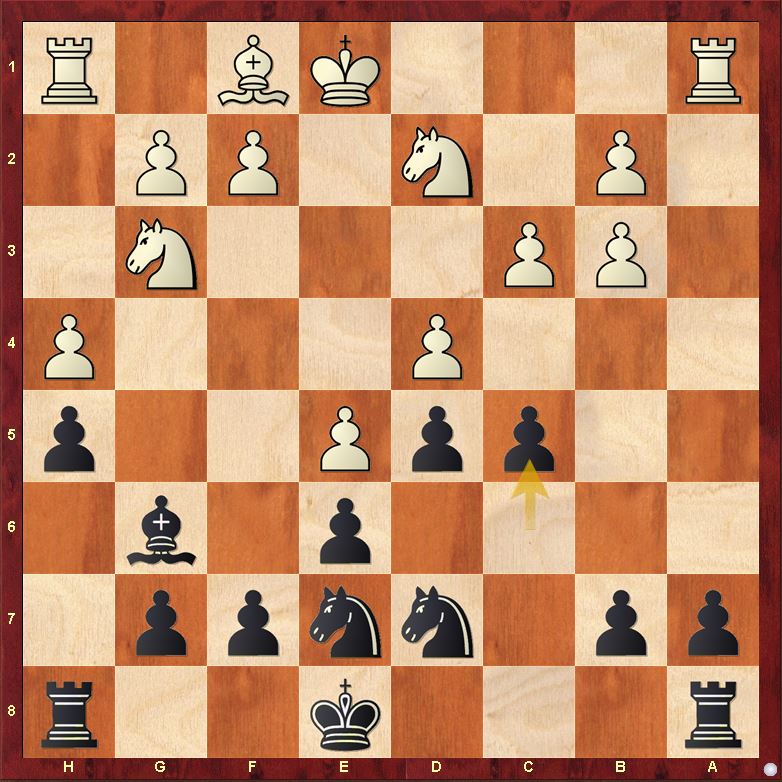
11.a4?! Bd5!
12.Qd1 b4! Diagram
I really hate myself with the 11.a4 blunder. I totally missed the power 11...Nd5 hard counter. Perhaps I was overly optimistic (I had won the first game, this is the second game played with the same opponent), and completely overlooked Black's ideas. From that moment on, I just felt horrible about my position from now on. The idea of 12.Qd1 is to move my Queen out of trouble. I am already unhappy with myself and don't want the Queen to be harassed anymore. Also, 12...b4 is very good in shutting down the Knight on b1.
LiveBook/Engine: 10.Qc2 is better. White has a few ideas, including but not limited to Rc1 (to attack c7), a3 (to stop ...b4 and facilitates Nb1-c3). If the Queen on c2 is harassed by a move like ...Be4, at least White has Qd1. With the f1 Rook brought to c1, this Queen retreat does not impede White from connecting the Backrank Rooks eventually.
13.Qe1 b5
14.Bg5 Nbd7
15.Nbd2 h6 Diagram
When I played 13.Qe1, I was hoping for some potential e2-e4 pawn push. I felt 14.Bg5 was necessary so that I can deploy the b1 Knight to d2. Otherwise, my Knight is stuck and I can't activate my Rook on a1. There is no doubt that White is worse, if not losing.
Engine: There is no doubt White is worse. On hindsight, 13.Qe1 is a waste of time. Instead, just skip this move and play 13.Bg5 immediately. With the White Queen still on d1, it is defending the a4 pawn. White must be prepared to give up the Bishop pair with natural move like e3 and try to strive for a setup that is "playable".
16.Bxf6 Nxf6
17.Rc1 Rc8
18.e3 c5 Diagram
White is trying it's best to catch up. I was uncertain about e4, and decided to play e3 instead, in case the e4 becomes an additional weakness for Black to exploit.
Engine: The verdict comparing 18.e3 to 18.e4 is not so clear. The evaluation slightly prefers e4 as it gains tempo. But this seems to be inherent engine bias. There are clear reasons/merits to consider e3 instead of e4. But if White sees itself as facing a desperate position, a more dynamic move of 18.e4 does seem better to complicate the situation (rather than 18.e3 and allow Black to continue the slow squeeze).
19.Qe2 Qb6
20.b3 Rc7
21.Rc2?! Ne4! Diagram
I did not realise that Black has Ne4-c3. So this is another complete loss of time.
Engine: Much easier is to play just 20.dxc5 -- The biggest threat from White is actually the potential to make a supported pass pawn. So let's kill this possibility when we still can.
22.Nxe4 Bxe4
23.Rcc1?! Rfc8
24.dxc5 Rxc5 Diagram
Engine: White should have tried the intermediate move of 23.dxc5, which makes it more difficult for Black to double Rooks on the c-file first. This will buy White a little bit more option on the fate of the c2 Rook.
25.Rxc5 Qxc5
26.Nd4 Bxg2
27.Kxg2 Bf6 Diagram
Engine: Black should have played this position more forcefully with 27...e5! which kicks the d4 Knight supporting the backward b3 pawn.
And now, in this difficult position (and time situation), White made a huge blunder which ended the game on the spot.
28.Nb5?? Qd5+!
0-1
The b3 pawn drops, Black pawns will promote and so White resigned on the spot. Quite frankly, White's mind was bothered by the position arising after 11...Bd5! throughout the game -- I kept thinking about it and lamenting how bad it was for me to miss it completely. Not saying that I will definitely find the saving 28.Rd1 if my mind was not messed up, but what I see as valuable lesson is that a) games can be lost if you get into a losing mentality, and b) objectively, a position, not matter how bad it may first appear, can be objectively very resilient. I have been repeating this point a lot, but I think the difference in mental resilience is a key difference between a good player and an average / club player.
Okay, I finally found the courage to face this bad loss face to face. There will only be more to come for as long as I continue to play chess. But I'd rather continue to play chess than to avoid the pain of losing a game through retirement from chess play =)
Summary of Learning Points
1. Mental resilience! The correct way to deal with a position, no matter how bad, is to deal with it at it's current state. One should not dwell in what has happened in the earlier moves. Easier said than done, I know.
This is not really a learning point for my own, but I'd like to take this chance to address chess parents who are ultra strict with their own kids just starting to pick up the game -- chess is really very difficult even for experienced / adult players! Hence, please remember to be kind and patient enough with your kids. Remember -- everyone had to go through the "beginner" stage in their bid to improve their game. Worse is to make the game of chess, already difficult to master, unenjoyable for them.
2. Avoid waste moves -- 13.Qe1 was a waste, and good intermediate moves like 23.dxc5 was missed. This should not be missed even in a bad situation. Need to hone the art of damage control, or pick correctly the "lesser of the evil".
3. Mid-endgames, pawn structures, typical weak areas of a club player =(
3. Be brave enough to face your losses, no matter how bad they were, and not just show-off your victories!
External Link to Game Replay
Thanks again.
Yours sincerely
Ong Yujing (Eugene)
a.k.a. newbie_learner
Siglap South CC Chess Quartet