Saturday, February 2, 2019

Maiden Arbiter for Defender VS Tyrant Blitz Match


Introduction
I was blessed by good chess friends who offered me to clock my maiden experience as an arbiter for their best-of-10 Blitz match. Both of them prefer to keep a low profile for the match, so unfortunately, the interesting things (photos and videos) taken will be within our private chat group. I shall only refer to the players as the "Defender" and the "Tyrant". The "Defender" is the best regular at the Singapore Chess Meetup, and the "Tyrant" is a well-known personality in the chess community.


Background to the Match
We had wanted to play a 10-game blitz match using "SPORTS HUB GIANT CHESS" set in the open. Unfortunately, upon clarification, we were informed that we need to make a request DAYS in advance for the pieces to be made available. (This is not a complaint, but a suggestion to make this requirement clear beforehand, preferably on the booking page itself. Currently, the "book now" button leads to writing an email, but it does not state such requirements.). Fortunately, there is another giant chess set in the Sports Hub Library, so we proceeded to play indoors (with air-condition!).

There were probably some under-estimation of the physical demands for the match. The Defender hit the gym earlier in the morning while the Tyrant did not clock adequate sleeping hours. Perhaps their fatigued, "not-so-handsome" look displayed by both players after the game contributed to their reluctance to allow pics or vids go public. There was another common friend, whom I shall refer to as "J", who served multiple roles (spectator, supporter, photographer, interviewer, assistance etc.)

There were some differences over the preferred time controls, but both players were eventually game enough to try out playing 3+2 (3 minutes initial time + 2 second increment with each move, starting from the first). Some house rules were necessary out of practical reasons. For instance, one is allowed to use both hands to make a move, to keep things in order, players were not allowed to start making their move before opponent presses the clock -- 2 warnings of this nature will result in penalty of an illegal move, adding 1 minute to the opponent. To address the lack of an extra Queen for pawn promotion, I brought 2 T-shirts, White and Black, from PubXChess -- a Queen will be represented by wrapping the shirt around any piece.


Conduct of the Games & Results
The warm-up game (not counted towards the results) was perhaps telling of the physical condition of both players. To our minor surprise, the Defender, who is deemed fitter than the Tyrant, seems very exhausted. The Tyrant, on the other hand, seems to be in much better condition. In the end, the Tyrant won the match 6-2 with 2 games not played out. A quick summary as follows:

Game 1: The Defender committed 2 illegal moves and forfeited the game. The Defender mixed up the pawn from the Bishop. But to be fair, even myself found difficulties sorting things out when restoring the pieces back to the starting positions =)

Game 2: The Defender threatened mate in 1 (big "one-move-threat") to even the scores.

Game 3: The Defender forfeited on time. Here I was rightfully reprimanded by the Tyrant from screwing up the clock -- in my eagerness to penalise the Tyrant for breaching the house rule (moving the piece before opponent pressed the clock), I accidentally pressed the clock (which triggered time increment) instead of pausing the clock =(

Things improved when the clock position was adjusted to a position which I can have a better look at the clock. Learn and avoid the mistake again was the way to move forward.

Game 4: The Defender committed 2 illegal moves again. One of the 2 illegal moves were so blatant (2 pawns were captured in a single move, LOL), that both myself and the Tyrant called it out. We were more surprised that the Defender was surprised by the (obvious) call ^o^

Games 5, 6, 7 and 8 were all decided by resignation.


Arbiter's Thoughts, Learning Points and "Match Report"
1. It was a very interesting experience. Both players were game, and it was an excellent physical and brain exercise combined!

2. I'm really sorry for the mistakes made as an arbiter. I will try to mimimise them in future. I'd also add that I am happy to say I have been impartial to both players. (The mistakes were due to lack of capability and not due to any bias towards either player). I have been penalising both sides quite evenly, in terms of warnings, calls for "touch-move" and the likes.

Just to digress a little-- Previously, as a player, I have never bothered claiming touch move on my opponent, because my personal view is that if a player intends to honour touch move, he would have done so at the onset (and hence, a claim is unnecessary). This assumption is actually not correct. Both players in this match are highly reputable, and both were reminded of "touch moves". Sometimes we are so focused in our thoughts, we are simply not fully aware of our hands actual actions. Both players honoured touch move after reminders.

So I should be doing the same as a player moving forward -- to "remind" my opponent of touch-move if they committed it (and not assume they have no intention to honour it just because they violated touch move).

3. While the players were taking their well-deserved break in between round, a teenager, who was following the game, approached me to inform that I overlooked an illegal move committed. Even though I thanked him and explained that the arbiter cannot interfere once the opponent made the move, the truth is I did not see/realise it. My point of view of the game was not so good, and I was focusing to ensure the house rules were being followed etc. My fear is that a seasoned / "lazy" arbiter would find all sorts of excuses to not play a proactive role.

4. I find fast games much harder to serve as an arbiter -- everything happens so fast, I am actually scared of pressing the clock (instead of pausing the clock) wrongly again. Even though the organisers, I have to say, I'd prefer to serve in standard games. I feel it is not so stressful, and if anything, we can always restore the game before the first irregularity. I don't mind committing longer hours to observe standard chess.

5. People (on top of Player) management is quite important. There was 1 user of the Sports Hub Library who complained about our noise level due to pieces falling and shouting out to make calls (e.g. warning, illegal move, touch move), stating the expected low to no noise level in a library. I apologised to him and the librarians after the match and wished them good day. I don't think there was a need to escalate the unhappiness further (luckily he did not hear the Tyrant's retort).

6. It is really important to ensure we understand the players correctly. The Defender indicated "giving up" during game 6, which results to the scores being 5-1 in favour of the Tyrant. I wanted to make sure I understood whether the Defender was giving up round 6 only, or was giving up the match. As the arbiter, I was actually secretly hoping that the Defender was giving up the match. Because being a pacifist, I hope the match ends as soon as possible, so that I can quickly proceed to apologise to "that guy" and avoid any escalation. But as a general chess enthusiast. I definitely wish the Defender would play the games out. I am glad that the games were played out to 6-2. It's scary how a match arbiter's bias can influence the course of the match, so I hope I, as well as any other aspiring chess arbiters, would take their role seriously!


Playing on the large chess board is quite an interesting affair. The Tyrant is already exploring possible interesting formats for the next match. Stay tuned!


Yours sincerely
Ong Yujing (Eugene)
a.k.a. newbie_learner
Siglap South CC Chess Quartet

Sunday, January 27, 2019

FIDE Arbiter's Seminar 25-27 Jan 2019

So I have passed the test in the Arbiter's Seminar, along a number of my chess friends. In fact, I have made a couple of friends in this course!

Missing in picture: Chin Lee -- Please photoshop yourself into the picture, my friend!

I really enjoyed myself -- a lot of my queries were addressed. There is this particularly interesting one. Although this was discussed at the seminar and I hold a minority's view, there was 1 younger arbiter (not a course mate, since we are not arbiters) who actually share my view. I will go through the Singapore Chess Federation to seek a clarification from the FIDE Arbiter's Commission.

In the meantime, this was the 'debate'.
Reference: FIDE Laws of Chess taking effect from 1 January 2018


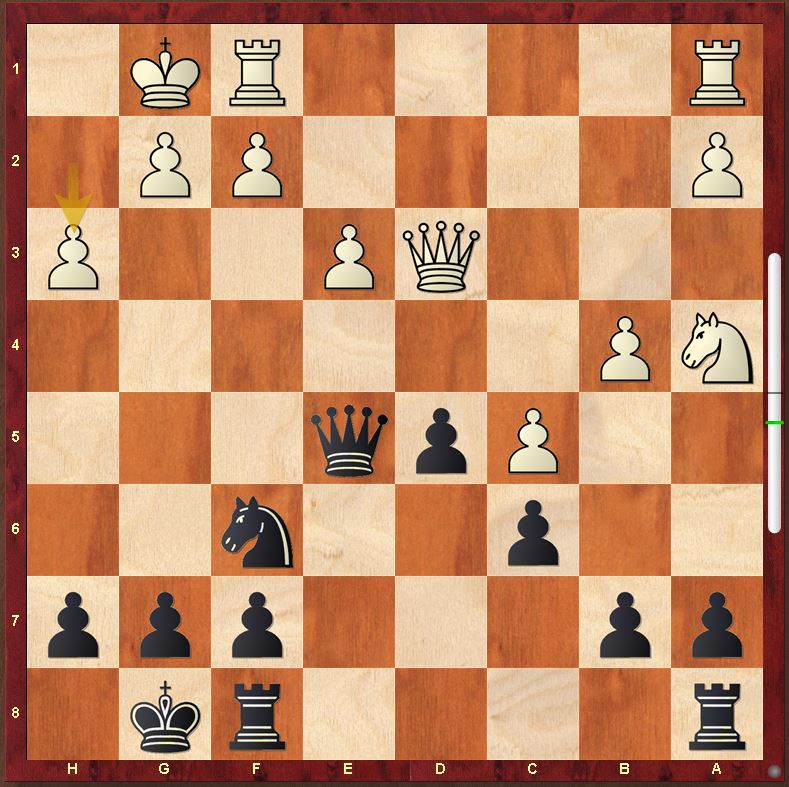
Hypothetical Situation: In the diagram position below, White, who has already made an illegal move in the earlier phase of the game, pushed his h7 pawn to h8 and pressed the clock (without actually changing the pawn to a promoted piece).


What we all agree
1. White has committed the second illegal move of the game.

"7.5.2 If the player has moved a pawn to the furthest distant rank, pressed the clock, but not replaced the pawn with a new piece, the move is illegal. The pawn shall be replaced by a queen of the same colour as the pawn."

"7.5.5 After the action taken under Article 7.5.1, 7.5.2, 7.5.3 or 7.5.4 for the first completed illegal move by a player, the arbiter shall give two minutes extra time to his opponent; for the second completed illegal move by the same player the arbiter shall declare the game lost by this player. However, the game is drawn if the position is such that the opponent cannot checkmate the player’s king by any possible series of legal moves."

2. There is no checkmate delivered under 'normal means'.

"5.1.1 The game is won by the player who has checkmated his opponent’s king. This immediately ends the game, provided that the move producing the checkmate position was in accordance with Article 3 and Articles 4.2 – 4.7. "

The "checkmate" was not delivered since this arises from an illegal move.

What I do not agree (with the rest of the majority)
Because White did not deliver checkmate, and he has committed 2 illegal moves, White forfeits the game. My argument, is that this interpretation and execution of the way the current laws are written did not fully execute the same articles referred. With deliberate emphasis in bold, I argue that even though White committed the second illegal move, the remaining half of the same articles should also be executed.

"7.5.2 If the player has moved a pawn to the furthest distant rank, pressed the clock, but not replaced the pawn with a new piece, the move is illegal. The pawn shall be replaced by a queen of the same colour as the pawn."
"7.5.5 After the action taken under Article 7.5.1, 7.5.2, 7.5.3 or 7.5.4 for the first completed illegal move by a player, the arbiter shall give two minutes extra time to his opponent; for the second completed illegal move by the same player the arbiter shall declare the game lost by this player. However, the game is drawn if the position is such that the opponent cannot checkmate the player’s king by any possible series of legal moves."

The essence of my argument
Why are we selectively applying part of the article rather than the full article? Even with the second illegal move, I should execute the latter part of Article 7.5.2. There is no choice, since this is specifically written in the laws!

So, the pawn that was pushed to h8 must be turned into a Queen.


And now, I apply the "second half" of Article 7.5.5:

Black has no legal moves to checkmate White, and the game should be drawn instead of White having to forfeit the game!

I am really grateful that even though a local Arbiter disagrees with my view (all but one arbiter present disagrees as well), he is at least agreeable to help me write to the arbiter's commission to seek a clarification. This is the type of people I look forward to work with: people who, despite having the different opinion, offers something that is constructive rather than going with "just take what I say as it is".

I genuinely believe I interpreted the FIDE Laws of chess correctly (this is a quality an arbiter needs right, be confident of your own judgement!). Unless, what Article 7.5.5 meant was that you only apply the action taken under Articles 7.5.1, 7.5.2, 7.5.3 or 7.5.4 at the first illegal move, and omit the actions when the second illegal move was completed. If this is the case, then it makes sense for White to forfeit, as the action to turn the pawn into the Queen need not take place.

But this was not how the Laws were interpreted or explained in any case. If this was the case, there should have been some clarification saying that we do not apply the actions taken under Articles 
7.5.1, 7.5.2, 7.5.3 or 7.5.4 at the second illegal move (which I highly doubt is the case). 


At most, if I am proven wrong, at least I truly learned something and clear my doubts on the laws.

In the meantime, if any of my friends and readers (including but not limited to Arbiters, fellow course mates etc.) have any views of pointers, please feel free to share.

I hope this was not a complete waste of your time! I find joy looking into trivial things in chess, and I hope you enjoy it too. If not, I hope you can find something more worthy of your time soon =)


Yours sincerely
Ong Yujing (Eugene)
a.k.a. newbie_learner
Siglap South CC Chess Quartet

Friday, January 25, 2019

Day 1 of FIDE Arbiter's Seminar

I felt super energised during day 1 of the FIDE Arbiter's Seminar held at the Singapore Chess Federation (25 - 27 Jan). I will try to make this short and sweet, so that I can sleep early for tomorrow's session commencing at 10am.

First the reference:
http://arbiters.fide.com/images/stories/downloads/2018/Arbiters-Manual-2018-v1.pdf
It contains explanatory comments by the FIDE Arbiter's Commission, which is useful to understand laws and certain situations. Although for purely chess players, the FIDE Laws of Chess would be sufficient I think.

Learning Points, Opinion and Remaining Queries [feel free to correct if I am wrong]
  • General sentiment: It may seem too harsh at times, especially for "kids events" to fully enforce the laws of chess.
  • General sentiment: The laws of chess has changed quite a bit over the years. Don't assume you know the correct things. Don't need to feel embarrassed if you don't know everything. Even a certain (former) world champion does not know how to make certain draw claims!
  • [With reference to Article 4.2.1] You are not allowed to say "I adjust" for each and every move to circumvent the obligation of "touch move". Players doing that should be warned / punished accordingly for repeated offences. Also, the purpose may only be used to correct displaced pieces. *Recalls his own tournament experience whereby players really make major adjustments of all pieces when they were not displaced in the first place (probably as a form of de-stress). This is actually an abuse of the allowed adjusting feature.*
  • [Practical advice for players] If an opponent makes a move such that a piece is placed cutting across more than 1 square, the best course of action is to pause the clock and seek assistance from the arbiter. It is actually not best for the player to pause the clock and request the opponent adjust the badly placed piece, because there is a risk of turning around and accuse the opponent that he/she was trying to adjust a piece not during his own move. So better let the arbiter address the situation. The player who placed the piece badly ought to be penalised.

    Follow-up question to ask: What if a player on his move, released a piece cutting across squares and then there is a dispute on whether the piece was placed on a square over the other? Should the player on the move be allowed to adjust (during his own turn) to make clear his intended move? I think the player should still be allowed to adjust, since it is still his move (move not completed), but will see what the course facilitator says.
  • [Practical advice for players] With reference to Articles 5.1.1, 5.2.1, 5.2.2 (as well as 6.2.1.1., 9.6.1 and 9.6.2)] While it is not necessary to press the clock when the move you make lands a checkmate, stalemate or a "dead position" (no legal moves to win for either side), as these are deemed to be completed moves, to avoid dispute, it is still better to press the clock, in case the clock falls to 0.00 and dispute arise over whether the move was made within time control.
  • (Opinion, in response to a good chess friends complain over an incident, whereby an opponent hesitates over which piece to use to complete a capture) -- A player with the move has quite a bit of rights -- it is his right to take his time to complete the move, including the action of making a capture. You can try to complain about distraction (he took away your piece but never complete the move / decide which piece to capture with), but an arbiter is most likely to disagree with the claim.
  • Simply by virtue of chronological order, if a player declares checkmate wrongly and then the opponent resigns (wrongly) when the position was actually a stalemate, the game result should stand as 1/2 - 1/2. This is because the stalemate position must have arrived before the wrong resignation. Personally, if I am ever serving as the arbiter, I probably would have also considered issuing a warning to the player who declared checkmate wrongly. But I also learn that this is probably not appropriate in a "kids event". I guess my etiquette as an arbiter may not be that desirable either ^o^
  • [General] A player should not ask, and an arbiter should not answer questions such as the number of moves made.
  • [Raised by course mate, with reference to Article 6.11.2, for discussion]
    Situation described as follows: "My opponent paused the clock and walked to get recording sheets."

    While the course facilitator agreed that the correct course of action was to pause the clock to ask for recording sheets from the arbiter, I personally really don't think it is that big a deal. I've seen events whereby the arbiter was there to provide the recording sheets for both players. So even though this might be a "wrong action", I really don't see anything particularly wrong about the opponent's act of pausing the clock to get the recording sheets. (Although so far, I would personally spend/waste that bit of time on my own if no arbiter is near sight).
  •  [General, Opinion] Time controls with neither increment nor delay really "sucks". Hopefully, all such tournaments will be phased out over time. Just think of any instance dragging the game out to win on time in drawn positions such as Rook v.s. Rook. Is that playing chess or engaging in a piece moving exercise? LOL
  • [With reference to Article 7.5.1] If multiple illegal moves had been completed and realised, we will restore game position to the last move whereby the position was still legal. The player who made the first illegal move in the series shall be deemed to have made 1 illegal move (2 illegal move forfeits the game), and touch move still applies. The arbiter has discretion over how the time situation over the clock shall be adjusted.
  • [Practical tips for players, with reference to Article 7.5.5] Since the punishment for making the first illegal move is that the arbiter shall give 2 minutes extra time to the opponent, the best way to address a completed illegal move, is to seek arbiter's assistance.
  • [Practical tips for players, with reference to Article 8.3] If you realise you recorded the moves wrongly, you can try to request to borrow the recording sheet of your opponent. You should do it only when your own clock is ticking, and return the borrowed recording sheet to your opponent before you complete your move (i.e. before pressing the clock). If you meet a situation whereby your opponent declines your request, you can still make this request to the arbiter. This is possible because "The scoresheets are the property of the organiser of the competition.", and most reasonable arbiters should grant such request. I guess if the arbiter refuses the player who requested, the requestor should really self-reflect on why the arbiter hates him/her, LOL
  • [This is an extremely hypothetical situation, whereby I'm still not fully clear after Day 1] Article 9.1.2.1 states "A playing wishing to offer a draw shall do so after having made a move on the chessboard and before pressing his clock. An offer at any other time during play is still valid but Article 11.5 must be considered. No conditions can be attached to the offer. In both cases the offer cannot be written and remains valid until the opponent accepts it, rejects it orally, rejects it by touching a piece with the intention of moving or capturing it, or the game is concluded in some other way."

    If you offer a draw without making a move, the opponent may request that you make a more while retaining the right to accept or decline the draw offer. The hypothetical situation I have is, what if, after the opponent offered a draw, I touched a piece which I cannot move? Should I be deemed to have lost the right to accept the draw, since I rejected it? Or since that move cannot be made, it should not be "registered"? Personally, I still go with my initial understanding, that this should indeed be deemed as rejecting the draw offer (this article is only concerned with whether the act of touching a piece was made with the intention of moving or capturing it, and not whether the move can or cannot be legally made), but there is still some uncertainty.

    Because no conditions can be attached to any draw offer, we cannot fix draws in team events (e.g. if you offer us a draw on board 1, we will offer you a draw on board 2).
  • A technicality which I observed correctly:

    Article 9.1.2.2 states that "The offer of a draw shall be noted by each player on his scoresheet with the symbol (=)."

    Article 9.1.2.3 states that "A claim of a draw under Article 9.2 (claiming draw whereby the same position arise for at least the 3rd time) or 9.3 (50 moves completed by each player without moving any pawn and without any capture) will be considered to be an offer of a draw.".

    My question: So if a player is making the "threefold repetition" claim or the "50-move" claim, both players should also indicate the symbol (=) on the scoresheet?

    Facilitator's reply: That is correct. But nobody actually does this.
    *Actually, I do! Great job for someone who likes to observe the trivial, unimportant details, LOL*
To be continued...


Yours sincerely
Ong Yujing (Eugene)
a.k.a. newbie_learner
Siglap South CC Chess Quartet


Sunday, January 20, 2019

Fun Games and Updates on 20 Jan 2019

A quick update on the Siglap South CC Chess Quartet:
  • "Sunday Chess Uncle", Eric, has finally returned after a few weeks' absence. And he did it with a bang, beating our #1 player, Seng Chin within the Chess Quartet. Now within the 4 of us (Seng Chin, Willim, Eric and myself), nobody has perfect record against each other anymore. 
  • If there is a way to monitor improvement, I think William definitely improved the most over recent days. His preparations and his games with Weng Chew probably helped (I personally do agree that we learn the most from long games).
  • Another reason I really enjoy games with William is because nobody else I played with played the way he does. Mainly opening choice but also a bit to do with playing style. At present, I find the opening very "technical" to play against. It's like the usual style of play I use doesn't work well at all =( But it's good. It makes my overall play experience more complete, I believe.
I really love it that everyone has levelled up. There were less attendees today as many were involved in the kickoff tournament held at Nanyang CC. I'm really happy to know many of my chess friends did well! Still, I hope everyone enjoyed themselves. I definitely played more blitz games than I wanted to, and I still have some big question marks in my head while reviewing some opening lines for sure.

This was the only rapid game I recorded, between William and myself.

Personal Thoughts and Learning Points
  • Being the first over-the-board (OTB) encounter against the Colle Zukertort, I thought it was decent. I mean, where I misplayed, I pick up and learn. So I learn that I can actually go directly with ...b6 and ...Bb7 without fearing any sort of early Bb5 pin.
  • I'm glad I at least realised the problem of 12...dxc4 right after playing it.
  • This was probably the biggest miss on my part. Interestingly, I had this exact move and idea in mind. But I was too fixated over the fear of getting the Black Queen trapped after 25...Qc2 26.Rf2!, and played an inferior move.
Position after 25.Rae1. Did you find the BIG MOVE for Black here?

  • After 29.Qh6!! Qd5 30.Be4 Qxe4 31.Rxe4 Bxe4 I was genuinely waiting for 32.Qf4 to resign. But White went astray with 32.h4 .Rc2. Even then, 33.Rf1 should still be okay but after 33.Ba8?? Black has the super strong 33...Rg2+ Kh1. But unfortunately, Black was living on incremental and did not see to converting a win.
Black has a guaranteed perpetual check with seconds left on his clock (15+10 format, 10 second incremental per move). Would you play this position out as Black?


The game replay in comparison with Chessbase15's "objective" Tactical Analysis can also be found here: 


Time to face the music in office again... Sorry, thank you for your time!


Yours sincerely
Ong Yujing (Eugene)
a.k.a. newbie_learner
Siglap South CC Chess Quartet

Saturday, January 19, 2019

Friday Evening Chess Happenings 18 Jan 2019

To my current knowledge, there are 2 chess sites on Friday evenings, namely Thomson CC Chess Club and Cashew Chess Club. I visited Thomson CC Chess Club, which is just 1 MRT stop away from my workplace, while William, a fellow member of the Siglap South CC Chess Quartet, made his way all the way to Cashew Chess Club to continue his match series with Weng Chew, the founder of the club.

Happenings at Thomson CC Chess Club
After losing a blitz game to a kid who also visits Siglap South CC Chess Club, I joined the endgame league series initiated by Mr John Wong. Fatefully, I was paired with his (younger sis), and both of us won with the White pieces from the following position. I got to say, I prefer her first move to mine, though I guess I managed to trick her somehow. 

First Endgame Position in Endgame League: White to move and try to Grind. Black to try and hold. 
(Players will swap sides trying to attack / defend the position.) In my first round, both my young opponent and I won with the White pieces.

Below was our attempt. I admit I feel that her choice of the first move with the White pieces felt  more forceful than mine. 


Personal Thoughts and Learning Points:
  • This is a good introduction to the Thomson CC Chess Club for learning. Honestly, even if the position is not winnable with objective best play from both sides, one needs to experience and learn how to play it out, how to try "grinding" as White and resist grinding as Black. While I'm disappointed that I failed to hold the position when playing Black, I hope I will learn the key things I ought to know, when the 'solution' is shared over next or next next week. 
  • Playing the position out is really important for learning and improvement (rather than offering / accepting draws every time, essentially giving up trying).
  • My endgame is bad, so I look forward to gaining more learning and experience in the subsequent game positions to come =) 
Happenings at Cashew Chess Club
While the endgame chess league was going on at Thomson CC Chess Club, the featured (90+30) game between Weng Chew and William took place at Cashew Chess Club.

The games (can compare my own attempt looking through the game, against Chessbase 15's "objective" tactical analysis) here:
http://view.chessbase.com/cbreader/2019/1/19/Game4538562.html

Personal Thoughts and Learning Points:
  • The opening phase of the game felt very sharp. I really didn't see 9.Qb1 (my bad). If anything, I definitely want to stay away from this type of opening / position in my own games =)
  • If Black wasn't seeing ghosts, the game could've ended as early as move 15 after 15...Bxg2. Opening play does matter -- the game can end that early. 
  • Endgames =) 
  • Towards the last part of the game, it felt like Black was trying to win at all cost. Even though Black failed, I feel that the effort and attitude is commendable. At the very least, this unsuccessful try teaches the lesson to not take excessive risks at times. It may also say a couple of things on the players' psychology -- ideal state of mind should probably be something like "staying as objective as possible, with no self-imposed obligations to win a game". Smart players should take a step further and always seek opportunities to place the "burden of proof" on their opponents for a psychological edge (e.g. If there is no way I can lose or become worse off in an arising position. I will just keep on playing, decline any offer of a draw and place the burden of proof on my opponent that he/she can play the position out correctly). 
These are just the newbie views of newbie_learner, so please take it with a pinch of salt. If you have any ideas or tips on how I can improve, please feel free to share!

Thanks again in advance, as always!


Yours sincerely
Ong Yujing (Eugene)
a.k.a. newbie_learner
Siglap South CC Chess Quartet

Sunday, January 13, 2019

Good Games at Siglap South CC Chess Club

Played a couple of good games at Siglap South CC Chess Club. Specifically, I got outplayed in 2 of the 3 games played at one point. Bad form on me in that I missed quite a bit of tactical things. But more importantly, I'm glad to see the progress of the kids.

To maximise learning value for everyone, esp. the kids, I'd try to share more tips as we go along. Of course, I will always qualify that I'm not an accredited trainer, and that everyone should always question what they are being taught/told.

(In chronological order)

Game 1


  • Overall, a "smooth" game. This particular line is something I play on both sides on a rather regular basis. I'm glad I remembered what I'd seen before -- 7.h3, as non-contributing to own development as it is, is a good move because it takes away the important g4 square away from Black's pieces and more importantly, allows the dark square Bishop to retreat to h2 should it be harassed by ...Nh5. 
  • I love my decision of 13.Qb3, offering to get my own pawns on the queenside wrecked for dynamic play, as well as the subsequent follow through while stifling Black to death.

Game 2


  • Bad on me to keep missing the tactical opportunities: 7...dxc4 and 9...dxc4
  • I really don't know how to generate play on the Queenside. Even though it is objectively not so good, I would really consider an early ...a6 to stop White from playing b4-b5 for good. Conceding the b6 square the White Knight is really not that big a deal (from Black's perspective).
  • More importantly, for long-term learning, I need to learn to appreciate how to play in this type of position.
  • White was completely winning at one point -- he should not have played at blitz rate just because Black is very low on time (living on incremental). Instead, White should slow things down while maintaining high quality moves.
White just played 17.h3 to take away the major threat of ...Ng4. The best move recommended is 17...Ne4, centralising, provoking weaknesses if White chases either the Black Knight or Queen. If White ignores it, Black can also consider consolidation with ...f7-f5.


Game 3


  • I forgot my opening analysis on Black's side =(  The best move after 10.Qxf3 is really 10...Qe7+. Because Black has the Isolated Queen Pawn, Black must really make the dynamic factors count. Every inconvenience that can be inflicted should be done! Even better if Black can inflict some damage on White's pawn structure along the way. 
  • Things could've been simpler with a prophylactic 11...h6 first, avoiding the Bg5 pin altogether.
  • Again, my judgement in this game is a little proof that I'm really not obsessed with the Bishop pair. After 12...Qb6!? I would have gone for 13.Bxf6 as White and inflicted further damage on Black's pawn formation, even though it costs White the Bishop pair.
After 12...Qb6!? I feel that the position is calling for 13.Bxf6 to be played.

  • Already not in good form today, but being low on time made the situation worse. One can never expect to play half as good as normal circumstances under time pressure.
I also played a mini blitz series with another adult chess player. On hindsight, we should've played on my DGT board instead, LOL.

Am curious to see how both these kiddos and other adult players including myself seek to improve with time! Caissa, please watch over us!


Yours sincerely
Ong Yujing (Eugene)
a.k.a. newbie_learner
Siglap South CC Chess Quartet

Saturday, January 12, 2019

Road to Arbiterhood for Chess Goddess Caissa!

(I think) this post may be of some use for:
  • newer chess players (or returning players) who do not know the current FIDE laws of chess very well;
  • experienced players who think they know the current FIDE laws of chess well (but may be surprised or even embarrassed to realise what they thought was correct, or have been doing in tournaments, is actually wrong) -- not blaming anyone, as some of the laws or the execution may not seem intuitive at first;
  • chess players or enthusiasts like myself who are interested in trivial things in chess (such as interpretation and application of the laws of chess, especially for unusual instances);
  • anyone who may find my article entertaining (even if it's laughable to you, I'm glad it served an entertainment purpose!)

Some Qualifiers Before We Begin
  • Some of the contents are not the final word on the matter -- if I am that good, I won't be needing to sign up for the upcoming FIDE Arbiter's Seminar organised by the Singapore Chess Federation ^o^ 
  • I will try to minimise my subjective opinion and focus on "what is correct based on the Laws of Chess" rather than "what I feel is a gentlemanly way to play a chess game". I have written on the latter before and have decided to remove my post. Will consider revising the topic on proper chess etiquette in chess should I feel comfortable / knowledgeable enough to share my views one day.

Why the Interest
Because I can see the value in contributing to the local chess community as an arbiter (or equipped with adequate knowledge to offer concrete tips and advice whenever the situation calls for it -- e.g. when a new player is playing his/her maiden tournament, when there are actual disputes in a game, even in a casual setting). 

I don't think I will ever get the norms required to become an arbiter (to do so means I have to sacrifice playing in the few local standard tournaments available, which I have no intention to stop playing at present), but if there are tournaments which I can volunteer in to gain practical experience, I won't mind. Also, if my own chess club @ Siglap South CC wants to organise any mini tournaments, I guess I can help.

My Reference Documents
I take feedback very seriously. One of the very beneficial feedback I received was the need for credible source. Currently, this is the best I found: FIDE Laws of Chess 2018 with comments by British Chess Arbiters’ Association. I feel that I gained a lot of insights from it, even thought there are minor comments which I personally do not fully agree with. Anyway, it is good to have a different view, if we simply accept everything we see, there's not much learning value / critical thinking I feel.

Laws Which I Feel Newbies in Chess Need to Know... and Why

  • 4.2.1 Only the player having the move may adjust one or more pieces on their squares, provided that he first expresses his intention (for example by saying “j’adoube” or “I adjust”).

    6.2.5 Only the player whose clock is running is allowed to adjust the pieces.


    This is important to know that you only need to say adjust once, because too many kids (and even a few adults) say "adjust, adjust..." for each adjustment they make on the same move, which can be quite irritating -- and disturbing the opponent is not allowed!

    Also worth noting is that you can only adjust pieces when you are having the move. 2 articles point this out! You are not supposed to adjust when it is your opponent's move. But based on my 3-year local tournament experience so far, "everyone" violates this requirement. Although it is debatable how serious this infringement actually is.

    The one situation which I feel in need of clarification (how players should react, how arbiters should facilitate) is, what happens when a player puts a piece cutting across 2 squares and pressed the clock? At present, I think the player who put the piece cutting across 2 squares ought to be penalised, but it would be a bit disruptive to do the corrective measures when time increment is concerned. This is 1 of the queries I intend to raise at the Arbiter's Seminar!

  • 6.11.2  A player may stop the chess clock only in order to seek the arbiter’s assistance, for example when promotion has taken place and the piece required is not available.

    6.11.4  If a player stops the chessclock in order to seek the arbiter’s assistance, the arbiter shall determine whether the player had any valid reason for doing so. If the player had no valid reason for stopping the chessclock, the player shall be penalised in accordance with Article 12.9.
    It is important to know that you can always seek the arbiter's assistance (by pausing the clock). Don't need to argue with your opponent and create a scene! Just note that if you do not have valid reason to do so, you can be penalised for disrupting the normal flow of the game.

  • 4.3 Except as provided in Article 4.2, if the player having the move touches on the chessboard, with the intention of moving or capturing:
    4.3.1 one or more of his own pieces, he must move the first piece touched that can be moved

    4.4  If a player having the move:
    4.4.1  touches his king and a rook he must castle on that side if it is legal to do so
    4.4.2  deliberately touches a rook and then his king he is not allowed to castle on that side on that move and the situation shall be governed by Article 4.3.1


    In layman's language, to perform a castling move, you need to touch your King first. If you touch your Rook first, it will be treated as if you intend to move the Rook rather than you intend to castle.  

  • 9.1.2.1  A player wishing to offer a draw shall do so after having made a move on the chessboard and before pressing his clock. An offer at any other time during play is still valid but Article 11.5 must be considered. No conditions can be attached to the offer. In both cases the offer cannot be withdrawn and remains valid until the opponent accepts it, rejects it orally, rejects it by touching a piece with the intention of moving or capturing it, or the game is concluded in some other way.

    9.1.2.2  The offer of a draw shall be noted by each player on his scoresheet with the symbol (=).


    11.5  It is forbidden to distract or annoy the opponent in any manner whatsoever. This includes unreasonable claims, unreasonable offers of a draw or the introduction of a source of noise into the playing area.

    What is important is how 9.1.2.1 is interpreted. If your opponent offers a draw without moving, you are entitled to request to see the move to decide whether to accept the draw offer or not. The draw offer stands.

    I still remember this incident a couple of years ago, when my opponent offered a draw without moving, I asked her to "show me your move", which she interpreted it as me rejecting her draw offer orally. Even though the arbiters ruled it in my favour (that I can still accept the draw offer), I learned the importance of making your intention clear. I have explained my request very clearly these days. "I am considering your (draw) offer, and would like to see your move to decide." I don't think anyone wants to always be surrounded by controversy, do they? =)

    It is not allowed to make unreasonable offers of a draw to distract or annoy the opponent. Since it comes with the plural "s", I would take it that it is permissible under the laws of chess to make 1 single insincere / annoying draw offer. Whether to do it or not (etiquette consideration beyond the coverage under laws of chess) is up to the player's own choice.

    Last but not least, it is good to record each and every draw offer (=) in case of a claim/dispute.


  • 6.2.3  A player must press his clock with the same hand with which he made his move. It is forbidden for a player to keep his finger on the clock or to ‘hover’ over it.

    7.5.1  An illegal move is completed once the player has pressed his clock. If during a game it is found that an illegal move has been completed, the position immediately before the irregularity shall be reinstated. If the position immediately before the irregularity cannot be determined. the game shall continue from the last identifiable position prior to the irregularity. Articles 4.3 and 4.7 apply to the move replacing the illegal move. The game shall then continue from this reinstated position

    7.5.2  If the player has moved a pawn to the furthest distant rank, pressed the clock, but not replaced the pawn with a new piece, the move is illegal. The pawn shall be replaced by a queen of the same colour as the pawn.

    7.5.3  If the player presses the clock without making a move, it shall be considered and penalized as if an illegal move.

    7.5.4  If a player uses two hands to make a single move (for example in case of castling, capturing or promotion) and pressed the clock, it shall be considered and penalized as if an illegal move.

    7.5.5  After the action taken under Article 7.5.1, 7.5.2, 7.5.3 or 7.5.4 for the first completed illegal move by a player, the arbiter shall give two minutes extra time to his opponent; for the second completed illegal move by the same player the arbiter shall declare the game lost by this player. However, the game is drawn if the position is such that the opponent cannot checkmate the player’s king by any possible series of legal moves.


    In layman's language, an illegal move (often involving but not limited to not addressing a King in check, or capturing opponent's King, not replacing the promoted pawn with a new piece) now includes pressing the clock without making a move, as well as using 2 hands to make a single move.

    If you made an illegal move but you have not pressed the clock, you are allowed to undo it while observing "touch move" (in article 4). This includes the realisation that you were using 2 hands to make a single move. You can undo the move made using 2 hands and now use 1 hand to handle the single move without incurring any penalty (other than spending the additional time taken to make this correction).

    Something of interest (more to the arbiters rather than the players) is that moving and pressing the clock with different hands is not an illegal move, but an illegal action.
  • 9.2.1  The game is drawn, upon a correct claim by a player having the move, when the same position for at least the third time (not necessarily by a repetition of moves):

    9.2.1.1  is about to appear, if he first writes his move, which cannot be changed, on his scoresheet and declares to the arbiter his intention to make this move

    9.3  The game is drawn, upon a correct claim by a player having the move, if:

    9.3.1  he writes his move, which cannot be changed, on his scoresheet and declares to the arbiter his intention to make this move which will result in the last 50 moves by each player having been made without the movement of any pawn and without any capture

    Under normal circumstances, we always make a move before we record our moves on the scoresheet. However, if we are claiming a draw whereby our move to be made will result in the same position arising for at least the 3rd time, or the 50th move by both players with neither any pawn movement or any capture, the correct way to claim it is to write the move you intend to make on the scoresheet (without making the move on the board), and declaring the intention to the arbiter.

    The reason, I believe, is that if you made the move over the board, the opponent can claim that you were actually making the move (and not intending to claim a draw). 
  • 5.2.2  The game is drawn when a position has arisen in which neither player can checkmate the opponent’s king with any series of legal moves. The game is said to end in a ‘dead position’. This immediately ends the game, provided that the move producing the position Was in accordance with Article 3 and Articles 4.2 — 4.7.

    6.9  Except where one of Articles 5.1.1, 5.1.2, 5.2.1, 5.2.2, 5.2.3 applies, if a player does not complete the prescribed number of moves in the allotted time, the game is lost by that player. However, the game is drawn if the position is such that the opponent cannot checkmate the player’s king by any possible series of legal moves.
    This is quite an important law to know. The reason I put this as the last article to highlight is that I am going to rant on this quite a bit.

    First, there is NO PROVISION to claim a draw under circumstances such as a) theoretical drawn positions; b) player with superior position but lower on time claim a draw. I was genuinely surprised that some (not just 1) of my chess friends made up their own ideas (probably based on their recollections of older versions of the FIDE laws of chess), that the player with a superior position can always claim a draw before his flag falls.  (Unless we are talking about Quickplay Finishes rule apply, which is extremely rare, if not non-existent in tournaments today.) I only hope my friends will actually read the revised versions of the laws on their own, and not risk spreading wrong information to the unknowing ones (who don't bother to read the Laws of Chess on their own to verify the correctness of what they hear).

    To put it in layman's language, if your flag falls, you are almost certainly "screwed". As long as there is any series of legal moves (not necessarily "logical" or "reasonable") for you to be checkmated, you will be deemed to have lost the game. And no, you cannot claim a draw just because you have a superior position. If I am mistaken on this, please let me know -- show me which article in the current FIDE laws of chess allowing such a claim.

    Second, this is probably not a problem under formats with time increments. Since players may not wish to extend the game with unnecessary moves (moving the pieces back and forth). But this may can an issue for a) formats with no time increments, and b) blitz games. I can't express enough my dislike hatred towards formats with no time increments, where the result of some games can arise from mindless pushing of pieces to claim a win on time.

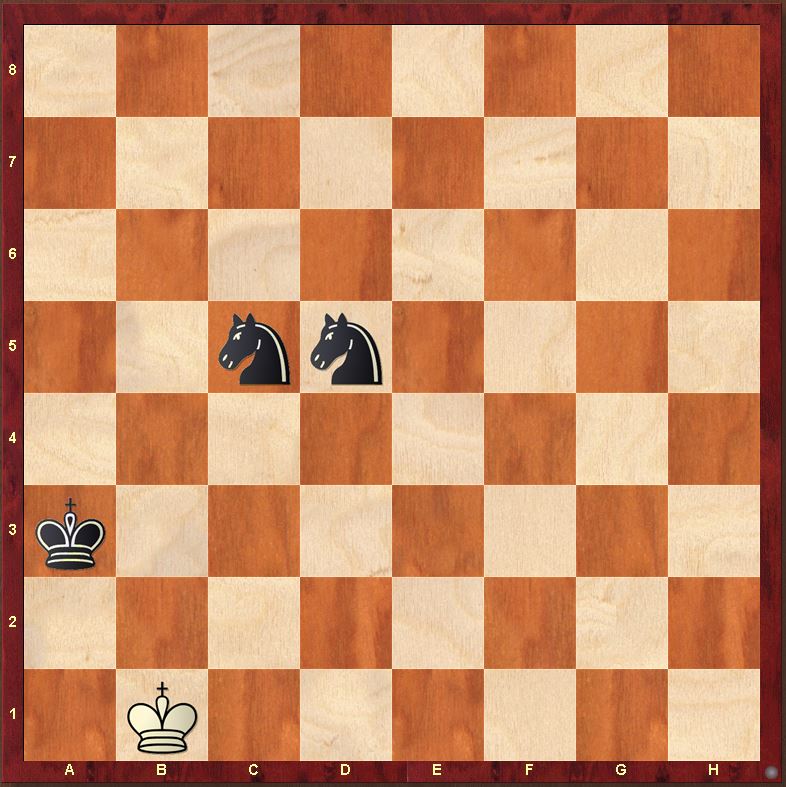
    Using the simplest example, in a Lone Rook v.s. Lone Knight endgame, the superior side (with the Rook) would be deemed to have lost the game if his flag drops, because the following checkmate position is possible through a series of legal moves:

Black to move, Black delivers checkmate with 1...Nc2#. 

  • Of course, "sensible" players would probably agree to a draw. But as players, the point of learning the laws of chess is to protect ourselves -- opponents are not obliged to live to our expectations and accept our draw offer, and to be fair, opponent is doing everything permissible (declining a draw offer) by the laws of chess to try to win. To address this situation, I would suggest that under non-incremental formats, if the superior side (with lone Rook) sees that the inferior side shows that he/she knows how to defend the position, and we are coming down to say the last 1-2 minutes, rather than risking to lose by time forfeit and continuing the grinding, initiate Rook takes Knight, or throw a Rook check beside the opponent's King -- once the Rook is captured, a dead position arises for a draw.

    Draw positions like lone Rook v.s. lone Rook, lone Knight v.s. lone Knight is not "automatically" drawn based on the current FIDE Laws of Chess, and will be a real problem under formats with no increments (esp. when 1 side is severely low on time). Hence I hope that most, if not all tournaments will start adopting formats with increments and stop using formats with no increments! In the FIDE Arbiter's Seminar to come, I will clarify if my understanding is correct. Really awkward to know that 2 Knights v.s. lone King will be ruled as a win for the side with 2 Knights... you get what I mean.
Self help mate can be delivered after 1...Nc3+ 2.Ka1?? 2.Nb3#. This is how it would be ruled should White's flag falls.

There are actually a lot more interesting situations and scenarios whereby there are some important interpretations or understanding required to "rule" correctly. I will probably share more knowledge and insights gained after going through the FIDE Arbiter's Seminar (to minimise the spread of wrong knowledge). Wish me luck!


Yours sincerely
Ong Yujing (Eugene)
a.k.a. newbie_learner
Siglap South CC Chess Quartet

Where to Play Chess in Singapore 2021 (COVID times)

It's probably been a year since I updated this chess blog. Due to the current global pandemic, over the board (OTB) chess has been so ba...