Again, I don't have time to do a very full review of the games played today. But I can say that the big tests and questions for me revolve around when to play ...c5. I think I over-prepared the pawn breaks too much, and got myself into bad positions.
External Link to the Games Replay (self-attempted review followed by Chessbase 15's Tactical Analysis):
http://view.chessbase.com/cbreader/2019/3/10/Game336914859.html
Do share your tips or pointers with me. Thanks ahead!
Yours sincerely
Ong Yujing (Eugene)
a.k.a. newbie_learner
Siglap South CC Chess Quartet
Sunday, March 10, 2019

Saturday, March 9, 2019
Frustrations at Club Level Chess
Even though I am nowhere near playing chess at a high level, there are frustrations experienced from time to time. The 2 typical sources of frustration I've experienced to date include:
(i) Frustration with myself -- this most often happens when we are upset with our own poor play. Which is fine. Negative emotions, not just positive ones, can make us grow as well. The negative feelings towards losing can make us strive towards improving our play.
(ii) Frustration with opponent -- Most of my (chess) friends find me decently-mannered (or so I believe ^o^), but there rare times when I am clearly unhappy after a game. This is usually arising from what I regard as poor etiquette. To date, the ones I have encountered are:


(i) Frustration with myself -- this most often happens when we are upset with our own poor play. Which is fine. Negative emotions, not just positive ones, can make us grow as well. The negative feelings towards losing can make us strive towards improving our play.
(ii) Frustration with opponent -- Most of my (chess) friends find me decently-mannered (or so I believe ^o^), but there rare times when I am clearly unhappy after a game. This is usually arising from what I regard as poor etiquette. To date, the ones I have encountered are:
- Offering a (sympathy / insincere) draw only to request to take it back. Isn't this the #1 thing when we start learning? There is no take back in chess. Not only that, it makes me feel like the opponent is playing mind games through illegal means (not allowed under the laws of chess).
- Taking back moves in a blitz match. Interestingly, I do not mind in games played, if you at least request to take back, or show that you are apologetic about it. What made me upset (and I told the adult opponent off immediately after the game) is that he took back numerous times and celebrated his win when he won by 2 seconds remaining in a 5+0. He claimed he thought that "clock-move" applies in blitz games instead of touch move. I just hope he now knows and would stop using the same (lame) excuse in future. Otherwise, I will just continue to walk away and play with others like what I did.
- Making a lot of redundant pre-game talks. I don't mind trash-talking amongst friends, but not the type which goes "I am a weak / new player" etc. and go on to trash me like nobody's business.
- Giving advice to my opponent during a game. Honestly, it spoils the whole game. I am playing my opponent, not you. If you (think you) are so good, we can play. But what to do? You've upset me so much, I have no desire to play with you at all =)
But of course, chess is just a game. Despite my frustrations, I'm glad they only lasted for that particular chess session. Despite my claims, I do not actually blacklist people who in my opinion, behaved badly. However, I do hope they learn and improve their own behaviour. Some players have shown vast improvement in their behaviour over time. I believe like the art of playing chess, proper chess etiquette needs to be learned and internalised over time as well.
Moving on to playing chess. I have to say, I feel that my play has deteriorated partly because of my recent obsession with blitz. I do stand by my views on the benefits of playing some blitz games (improved nerves playing under severe time pressure, quick check of opening lines and general tactical sensing), but I do feel that my play, specifically my thinking process seems a bit shallow.
The following is a recent game I played with a kiddo opponent. Even though I won, I don't think I played well at all.
Kiddo v.s. newbie_learner
Rapid time control (15 minutes initial time with 10 seconds increment per move starting move 1)
1. d4 d5
2. c4 c6
3. Nc3 Nf6
4. Bf4 g6 Diagram

I have played quite a number of games against the Slav Defence on both sides, but I have forgotten about an early Bf4. Frankly, I was not sure if what I played made sense. But I thought it was worth at least a try. Also, the #1 on my mind in this question is, whether Qb3 at any moment will "kill Black". I do not enjoy self-inflicting doubled isolated pawns on b7/b6 after ...Qb6.
5. e3 Bg7
6. Nf3 O-O
7. Bd3 Bf5?! Diagram

Even though I wanted to try playing different from my usual play, I think this is outright bad. Sticking to my own advice, after 8.Bxf5 gxf5 9.Qb3 looks outright good for White. White is exerting a small pressure at no risk. If I can replay this move, I would have tried 7...Bg4 instead. Now if White insists on 8.Qb3, 8...Bxf3 (9.Qxb7 Bxg2 I don't believe White has anything either) 9.gxf3 Qb6 is fine for Black to me.
8. O-O e6
9. Bxf5 gxf5
10. Ne5 Nbd7
11. Bg5 Qc7 Diagram

9...gxf5 seems quite self-weakening on my Kingside (esp. when I'm not ready to with ...Rg8 to take the g-file under control, but I did not want to do 9...exf5 because again, I do not enjoy the pressure after Qb3. I actually am not sure of what to do if White does 12.Bf4. I probably have to initiate 12...Nxe5 and see where to relocate my Queen after 13.Bxe5.
12. f4 Ne4
13. Nxe4 dxe4
14. Nxd7 Qxd7


15. Qb3 Qc7 Diagram

I felt 12...Ne4 necessary to generate something out of a rather passive position. I do feel that my young opponent over-exchanged a little. After these exchanges, I just want to exchange further to simplify the position! I chose 13...dxe4 over 13...fxe4 because I am more concerned over f4-f5 push as compared to d4-d5 push. I played 15...Qc7 because I am trying to stay out of trouble (potential open d-file facing White's Rooks) and I am looking for ...Qb6 as a resource.
16. Rac1 Qb6
17. Rc3 Qxb3
18. Rxb3 f6
19. Bh4 Rf7 Diagram

Okay, I got to execute what I wanted -- exchange Queens to simplify the position. 18...f6 and 19...Rf7 was planned -- I wanted to block out White's dark square Bishop so that I will get to double Rooks on the d-file. 19...Rf7 is what I consider a little move to expedite the doubling of Rooks and to defend the b7 pawn at the same time.
20. Rd1 Rd7
21. Be1 Rad8
22. Ba5 b6
23. Bb4 c5 Diagram

I do believe I managed to repel my inexperienced opponent's moves. The culprit probably started from 20.Rd1 which gave me ideas to exploit the position, exploiting the pin on the unsupported d1 Rook.
24. Bc3 cxd4
25. Bxd4 e5 Diagram

The last 2 moves were consistent in exploiting the pin against White's unsupported Rook on d1. The game is essentially over. The remaining moves as follows:
26. Rb5 exd4 27. exd4 Rxd4 28. Rxd4 Rxd4 29. Rxf5 Rxc4 30. Kf2 Rc2+ 31. Ke3 Rxb2 32. Kxe4 Rxa2 33. Rd5 Rxg2 34. Rd8+ Kf7 35. Rd7+ Ke6 0-1
External link to replay the game with Chessbase 15's one-click tactical analysis function can be found below:
Yours sincerely
Ong Yujing (Eugene)
a.k.a. newbie_learner
Siglap South CC Chess Quartet
Sunday, March 3, 2019
...c6 Day at Siglap South CC & More
It was almost a Caro-Kann Day for me if not for 1 of the games which turned out to be the Semi-Slav instead. Also, I happen to be looking at my White repertoire but I played Black in all my games today ^o^
Again, I don't have that much time before the commencement of the work week, so I will be relying largely on Chessbase 15's Tactical Analysis.
External link to the 4 games played: http://view.chessbase.com/cbreader/2019/3/3/Game126546515.html
To the Siglap South CC Chess Club Kids: If you happen to see this by any chance, please SLOW DOWN when you play a rapid game! I find your time management in some of your games played amongst yourself really awkward. In a 15 + 10 (15 minutes initial time + 10 seconds increment per move starting from the first move), some of you ended the game with more time than your initial 15 minutes... Yes, you can play fast in the opening phase of the game if you are super familiar, but from what I saw, you are not as familiar as you think. So yeah, please slow down to minimise the possibility of unforced errors!
Today, there were more interesting things that the chess games themselves.
More #1: Advice Sought on Ruling of An Incident At Another Chess Site
I was pleasantly surprised to see a message from a chess facilitator of another site, seeking my advice on the following scenario.
Situation
Player A claimed a win through flag fall. Player B made a counter-claim that Player A distracted Player B by making the claim, when Player B originally still had 1 second left on the clock. In plain words, Player B is claiming that Player A's bogus flag fall claim caused a distraction. This distraction resulted in the actual flag fall that happened.
My Initial Advice
First, calm the players down.
Second, I was getting more information and details from the facilitator (establishing facts to the best we can).
Evaluation


Again, I don't have that much time before the commencement of the work week, so I will be relying largely on Chessbase 15's Tactical Analysis.
External link to the 4 games played: http://view.chessbase.com/cbreader/2019/3/3/Game126546515.html
To the Siglap South CC Chess Club Kids: If you happen to see this by any chance, please SLOW DOWN when you play a rapid game! I find your time management in some of your games played amongst yourself really awkward. In a 15 + 10 (15 minutes initial time + 10 seconds increment per move starting from the first move), some of you ended the game with more time than your initial 15 minutes... Yes, you can play fast in the opening phase of the game if you are super familiar, but from what I saw, you are not as familiar as you think. So yeah, please slow down to minimise the possibility of unforced errors!
Today, there were more interesting things that the chess games themselves.
More #1: Advice Sought on Ruling of An Incident At Another Chess Site
I was pleasantly surprised to see a message from a chess facilitator of another site, seeking my advice on the following scenario.
Situation
Player A claimed a win through flag fall. Player B made a counter-claim that Player A distracted Player B by making the claim, when Player B originally still had 1 second left on the clock. In plain words, Player B is claiming that Player A's bogus flag fall claim caused a distraction. This distraction resulted in the actual flag fall that happened.
My Initial Advice
First, calm the players down.
Second, I was getting more information and details from the facilitator (establishing facts to the best we can).
Evaluation
- As subsequent confirmed by the facilitator, it was hard to prove Player B's claim of distraction.
- Under normal circumstances, claims of distraction should be made during the game, not after the game is over.
- As a matter of fact, Player B's flag did fall.
Recommended Judgement
- Player A wins as Player B's flag falls (assuming that there are still legal means for Player A to deliver checkmate based on the final position on the board).
- If the organiser / facilitator would like, remind players that they can only claim a flag fall after it actually happen (i.e. timer hits zero).
Unlike most other chess arbiters, I feel that such incidences ought to be publicised and discussed. Please let me know if you have a different opinion, or additional ideas on how the situation could've been better handled or judged.
More #2: Even DGT's Plastic (non-electronic) Set Looks Simply Gorgeous!
(Disclaimer: I am not affiliated to DGT in anyway, but I am a really happy customer that has absolutely nothing but praises of the purchases I made so far!)
So I ordered a Club Pack (10 sets of chess pieces and cardboard chess board). 10 sets cost me approximately SGD $350 (incl. shipping), so each set is around $35, which is very reasonable. More importantly, it looks so beautiful. I feel that the plastic set is "normal" (despite feeling sturdy), but the board is really beautiful. Let the pictures I took speak for themselves!


Again, I'm pleasantly surprised to hear the chess parents at Siglap South CC ask me about them. (I brought 5 sets for the club's future use. Hopefully, the King's don't end up headless again. Please be gentle with them, kids!)
Just in case, there are 2 minor issues I had with the sets. They are not deal-breakers for me, but I believe one should be given enough information to make an informed decision.
Only shortcomings I observed:
- Sets do not come with an extra Queen (most "modern" chess sets we buy do have an extra Queen to facilitate pawn promotion); and
- Pieces may be covered with a light layer of greenish powder. That is actually the powder/dust from the felt. But it can be wiped clean easily.
Dear reader, thank you again for your time and patience to come to the end!
Yours sincerely
Ong Yujing (Eugene)
a.k.a. newbie_learner
Siglap South CC Chess Quartet
Friday, March 1, 2019
A Lost Training Game...Oh Capablanka(!)
I guess the title says it all. These days, whenever I lose a chess game, I shall watch this video! May this be able to help Juga get 1 million views and more earlier ^o^
Okay, I'm sorry but my opponent didn't play the Caro-Kann in this game =) It was the King's Indian Defence, something which I have a really disastrous result as White.
Time control was 45 minutes initial time with 30 seconds increment per move.
White: newbie_learner
Black: adult player
1.d4 Nf6 I really should consider exploring 1...Nf6 as an alternate move when playing Black myself. It is really more flexible than 1...d5 all the time.
2.Nf3 g6 These days, I like to insert 2.Nf3 to confirm what setup Black is going for. Indeed, the King's Indian Defence (KID) is coming. And there is this non-mainstream move I have been dying to try out. I do not enjoy playing over the internet, hence my games are all limited to Over the Board (OTB) ones. Which move would I be testing out?
3.Nd2 (Diagram)

In my previous tournament (SG Amateurs 2018), I have actually used 3.Nc3 consistently. But I felt that the response of 3...d5 was too good -- White has no pawn duo with either c4 or e4, while Black will always have the ...c5 pawn break at his disposal. Hence, the idea of 3.Nd2 to not only sidestep the mainstream options, but also to keep White's options of c4 and e4 open. After 3.Nd2, if 3...d5 is played, at the very least White still has the option to insert c4.
Do you think 3.Nd2 is a good reason in view of 3.Nc3 d5 ? Please share your views with newbie_learner so that he has chances of improving! Thanks ahead =)
4.e4 d6 White still got tempted to go for the ideal pawn centre. Nothing wrong, just that if White wanted to stay flexible, I think 4.g3 can still be justified.
5. Be2 0-0 White is really playing timidly here. White did not want to face ...Bg4 pin and did not want to waste a move on h3, although in the mainlines, h3 is quite valuable is shutting down Black's options for the light squared Bishop. Hence, the thinking that 5.Be2 discourages ...Bg4 to begin with. Moves like 5.Bc4 and 5.Bd3 look better. But I'm not sure if the Bishops are better placed there -- placing the Bishop on c4 contradicts my idea of playing b3, Bb2 c4, while placing the Bishop on d3 when Black's Kingside structure involves a g6 seems to blunt the Bishop's attack on Black's Kingside.
6. 0-0 Nbd7 (Diagram)

7.b3 c5
8.Bb2 a6
9.c4 b5! (Diagram)

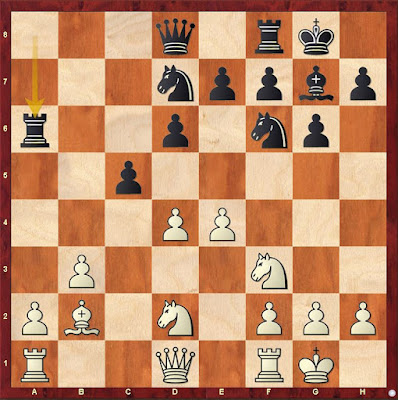


I admit I was playing hope chess with 27.Qa3, that Black would play 27...Qxa4. Black didn't fall for it, and I knew in my heart gg was coming =)
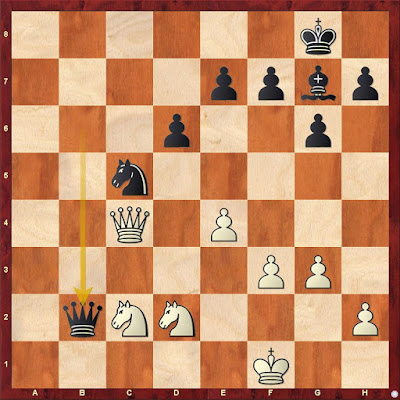
Okay, I'm sorry but my opponent didn't play the Caro-Kann in this game =) It was the King's Indian Defence, something which I have a really disastrous result as White.
Time control was 45 minutes initial time with 30 seconds increment per move.
White: newbie_learner
Black: adult player
1.d4 Nf6 I really should consider exploring 1...Nf6 as an alternate move when playing Black myself. It is really more flexible than 1...d5 all the time.
2.Nf3 g6 These days, I like to insert 2.Nf3 to confirm what setup Black is going for. Indeed, the King's Indian Defence (KID) is coming. And there is this non-mainstream move I have been dying to try out. I do not enjoy playing over the internet, hence my games are all limited to Over the Board (OTB) ones. Which move would I be testing out?

In my previous tournament (SG Amateurs 2018), I have actually used 3.Nc3 consistently. But I felt that the response of 3...d5 was too good -- White has no pawn duo with either c4 or e4, while Black will always have the ...c5 pawn break at his disposal. Hence, the idea of 3.Nd2 to not only sidestep the mainstream options, but also to keep White's options of c4 and e4 open. After 3.Nd2, if 3...d5 is played, at the very least White still has the option to insert c4.
Do you think 3.Nd2 is a good reason in view of 3.Nc3 d5 ? Please share your views with newbie_learner so that he has chances of improving! Thanks ahead =)
4.e4 d6 White still got tempted to go for the ideal pawn centre. Nothing wrong, just that if White wanted to stay flexible, I think 4.g3 can still be justified.
5. Be2 0-0 White is really playing timidly here. White did not want to face ...Bg4 pin and did not want to waste a move on h3, although in the mainlines, h3 is quite valuable is shutting down Black's options for the light squared Bishop. Hence, the thinking that 5.Be2 discourages ...Bg4 to begin with. Moves like 5.Bc4 and 5.Bd3 look better. But I'm not sure if the Bishops are better placed there -- placing the Bishop on c4 contradicts my idea of playing b3, Bb2 c4, while placing the Bishop on d3 when Black's Kingside structure involves a g6 seems to blunt the Bishop's attack on Black's Kingside.
6. 0-0 Nbd7 (Diagram)

7.b3 c5
8.Bb2 a6
9.c4 b5! (Diagram)

Black has just offered a gambit play which resembles the benko gambit. To be honest, I have never taken the gambit seriously. I see it as "Black drops a pawn" =) But I have to say, White must know how to keep the extra pawn effectively, as this game shows.
Engine: White's attempted structure does not work here. After 7...c5, Rather than 8.Bb2 which gives up the pawn centre after 8...cxd4 9.Nxd4, the recommendation is 8.c3 to hang on to the pawn centre. Also, for Black, this whole gambit with 9...b5 is not correct.
10.cxb5 axb5
11.Bxb5 Ba6
12.Bxa6 Rxa6 (Diagram)
13.Qe2 Qa8 To me, after 12.Qe2, White has completed his opening development by connecting his backrank Rooks. The Queen on e2 is well-placed in that it aims at the Black Rook on a6, and the Queen also helps to defend the pawn on e4. What else can White want from the position? After 12...Qa8, Black does pose a big question on White: How does White want to set up the pawn structure over the Queenside? 13.a4 is the first candidate move on my mind, since it liberates the Rook on a1 of it's defensive duties, and on a good day, White may be able to place his Knight on the b5 outpost. But I also saw that the pawn on b3 becomes super weak. Hence, I was hesitating and considering a more modest advancement of 13.a3 instead. My argument is that after 13.a3, White still retains flexibility over how to advance the Queenside pawns.
14.a3?! Rb8 If anything, both players and spectators agree that 13.a3 is the key culprit to White losing the game in the end. It is that bad. White should have seen that the b3 weakness is at least not an immediate concern as the pawn is defended by the d2 Knight. Now all of White's pieces are stuck. All because of a small little mistake in pushing a pawn!
15.Rfc1 cxd4 Black was very effective in posing immediate problems to White.

Position after 15...cxd4. I don't like it for White already.
Engine: While 14.a4 was the best move, 14.a3 was not that bad. 15.Rfc1 was a slip, but even then, White was not worse. Best move is 15.d5 so that Black don't get to exploit the undefended Bishop on b2 by pinning. Good alternatives for White also include 15.Rab1, 15.Rac1 and even 15.Rfe1. White has misread the position here.
16.Nxd4 Nc5 White did not have a choice in recapturing on d4 as the Bishop on b2 was committed to the defence of the a3 pawn. That was the whole problem with 14.a3?! 16...Nc5 is good in continuous harassment of White's position.
17.f3 Nfd7 Actually, I did notice the possibility of 17...Na4 immediately at this position to the remaining sequence of moves. But does White have anything better? If there is, I didn't see anything meaningful during the game.
18.Qe3 Ne5 (Diagram)

Black is threatening a lot of things. ...Ned3 is one, ...Na4 is one. I am not trying to solve all the problems at the same time, but try to address the problems 1 by 1, move by move.
Engine: 17.f3 was the real losing move. Best was 17.Nb5! threatening Nc7. I actually saw this idea, with a4 to follow, but did not play this because I thought the best thing to do was to play f3 to relief the Knight on d2 of it's defensive function over e4. But this actually allowed for some pretty immediate tactical shots. Even if Black misses the tactics, Black will remain slightly better-off.
Also, instead of 18.Qe3, play 18.Bc3 instead -- better accept an inferior position but try to improve the situation through reduce the constraints / "binds" imposed on White. After 18.Qe3, White is essentially lost with all the tactical chances for Black everywhere.
19. Rc2 Ned3
20. a4 Nxb2
21. Rxb2 Nxa4 (Diagram)
As mentioned, it is not as if White didn't see this coming. Rather, White can't stop it from happening anyway.
22.Rba2 Nc5
23.Rxa6 Nxa6
24.Ra4 Rb4 (Diagram)

After the game, my opponent told me that I should have tried 24.Qd3 instead. It does seem better in that it encourages exchange of Queens, I think.
25.Nc2 Rxa4
26.bxa4 Nc5
27. Qa3 Nxc4 (Diagram)

I admit I was playing hope chess with 27.Qa3, that Black would play 27...Qxa4. Black didn't fall for it, and I knew in my heart gg was coming =)
28. Qd3 Qc6
29.Qc4 Qb6
30.Kf1 Nc5
31.g3 Qb2! With multiple threats, e.g. ...Bc3 coming, White resigned.
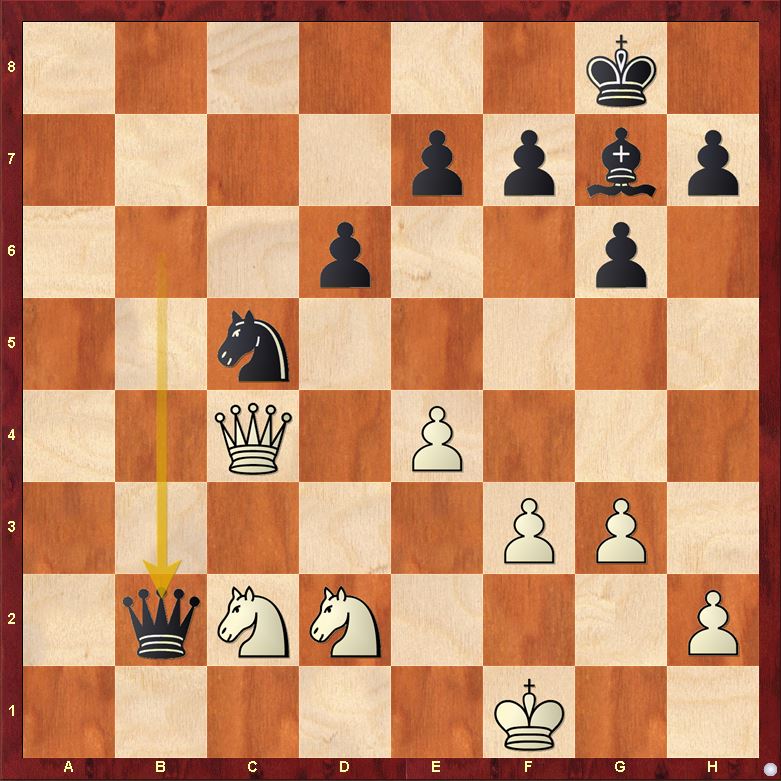
0-1
Game replay using Chessbase 15's "Tactical Analysis" can be found on the following link:
General Learning Points / Concluding Thoughts
- It is always difficult playing in an unfamiliar position. I think I am actually quite bad with the ideal pawn centre. But if I don't try, I will only remain bad with such positions =) I'm not attributing my loss to 4.e4, but I do feel that 4.g3 type of wait-and-see suits me better =)
- Same thing that I don't handle dynamic positions well enough.
- Despite the bad play, I managed to remember and reconstruct the game without referring to my game recording. If that shows decent memory / visualisation, that's good!
- For now, I'd say that 3.Nc3 d5 or 3.Nd2 all have their comparative merits and drawbacks. There are still a couple of non-mainstream ideas I'd like to try out.
Yours sincerely
Ong Yujing (Eugene)
a.k.a. newbie_learner
Sunday, February 24, 2019
Siglap South CC Chess Games 24 Feb 2019
I don't have enough time to finish reviewing my own games, so I have to be contented with Chessbase 15's 1-click Tactical analysis will have to do for now. As a "value-add" to fellow players at Siglap South CC, I'm sharing the moves of all games captured on my DGT Board today.
Click the following link for the games replay:
http://view.chessbase.com/cbreader/2019/2/24/Game713644265.html
Yours sincerely
Ong Yujing (Eugene)
a.k.a. newbie_learner
Siglap South CC Chess Quartet
Click the following link for the games replay:
http://view.chessbase.com/cbreader/2019/2/24/Game713644265.html
Yours sincerely
Ong Yujing (Eugene)
a.k.a. newbie_learner
Siglap South CC Chess Quartet
Friday, February 22, 2019
Back to Playing Slower Chess
Admittedly, I have been playing and enjoying my role as a chess arbiter and partial organiser / facilitator. I still have the passion to play as well. It is not that I have not been playing much chess, hence my less recent sharing of games played. Rather, I have been playing quite a bit of unrecorded blitz games. To my surprise, my personal blitz results have improved A LOT compared to my past year(s) -- my personal chess friends could testify that my blitz play was "a joke" -- with the exception of my games played with William at Siglap South CC. (I have been whitewashed recently, but that'll be another chess story ^o^).
I have been lamenting that my play these days felt superficial. Hence, all the more these slower games felt even more precious and valuable. I have consolidated 2 such games played over the past few weeks, recording a win and a very painful loss. In both games, I play with opponents who we are very familiar with each other's play.
Again, I need to qualify that I'm just a chess enthusiast seeking to improve my game through reviewing my own thought process and decision making. In no way am I trying to give (bad) advice. But if you have any (good) advice for me, please feel free to drop a comment or PM me. Thanks ahead!
I first attempt analysing/reviewing the game on my own, followed by guessing the things I missed based on the Engine (Stockfish 10's) evaluation numbers. Corrections / Insights from the Engine will be marked in red bold.
Game 1: Adult Opponent (similar profile) v.s. newbie_learner
Time control: 45 minutes initial time, with 30 seconds increment per move starting from move 1.
1.e4 c6
1.e4 c6
2.d4 d5
3.e5 Bf5
4.h4 Diagram

What is worth mentioning in this position? My current view of the position as follows: The main reason for Black to bring the Bishop to f5 (or choose to play the Caro Kann defence in general), is so that Black can continue with ...e6 so that the light square Bishop is developed outside the pawn chain (to avoid having the bad Bishop problem present in other openings like the French Defence). After 4.h4, Black needs to be a bit cautious. Black cannot play 4...e6 immediately, because of 5.g4 and the light square Bishop will run out of squares. This suggests a need for Black to consider either 4...h5 or 4...h6 to give an escape square for the Bishop. Which one will I choose, and why?
Perhaps worth mentioning is that if White insists on forcing Black change a plan, he can play an immediate 4.g4 first. Then Black must be prepared to consider a chance of plan as Black has no time for ...e6 while keeping the light square Bishop outside the pawn chain. But that's another story.

What is worth mentioning in this position? My current view of the position as follows: The main reason for Black to bring the Bishop to f5 (or choose to play the Caro Kann defence in general), is so that Black can continue with ...e6 so that the light square Bishop is developed outside the pawn chain (to avoid having the bad Bishop problem present in other openings like the French Defence). After 4.h4, Black needs to be a bit cautious. Black cannot play 4...e6 immediately, because of 5.g4 and the light square Bishop will run out of squares. This suggests a need for Black to consider either 4...h5 or 4...h6 to give an escape square for the Bishop. Which one will I choose, and why?
Perhaps worth mentioning is that if White insists on forcing Black change a plan, he can play an immediate 4.g4 first. Then Black must be prepared to consider a chance of plan as Black has no time for ...e6 while keeping the light square Bishop outside the pawn chain. But that's another story.
4...h5
Objectivity aside (whether 4...h6 or 4...h5 is better), this is the only move that denies White from playing g4, to kick the light square Bishop. This assures Black that he can still play the usual play of ...e6 with the light square Bishop outside the pawn chain. Of course, this is not without any drawbacks. First, the Black pawn on h5 could be more vulnerable compared to placing it on h6. Second, the g5 square is potentially weak as the only way to control it using a pawn move is ...f6.
5.Ne2 e6
6.Ng3 Bg6
7.Bg5!? Diagram

An interesting idea. White is trying to defend the h4 pawn weakness before working on attacking h5.

An interesting idea. White is trying to defend the h4 pawn weakness before working on attacking h5.
7...Be7!?
Here, my thinking during the game, is to gain tempo if White initiates Bxe7 (If necessary, I will place my Knight from e7 to f5 to encourage an exchange of Knights on f5, so that the more natural ...g7-g6 can eventually be played. In addition, my thinking was to clarify White's intention before I consider some Queenside moves/development like ...Qa5+ or Bb4+. I had wrongly considered the possibility for White to play f4, which would have failed to ...f6! which the Bishop on g5 seems to have run out of squares (unless he gambits a pawn with f4-f5).
During our post-game review, my opponent suggested an easy and seemingly good 7...Qb6! which seems much better than my 7...Be7 that was played. Black attacks the b2 pawn while developing his Queen. I have thought of it, but I think I was misled by irrational fear-- I had been making bad Queen placements in the past. Hence, I have been avoiding early Queen development for a while in all my games.
Engine: Indeed, 7...Qb6! is the best, and the engine deems this as "Black is clearly better". I must cast aside my irrational fear based on past bad experience of misplacing the Queen to improve!
8.Bxe7 Nxe7
9.c3 Nd7
10.Nd2 Qb6!? Diagram

With 9.c3, I thought that White has already blunt Black's ...Qb6 significantly. Hence, I chose 9...Nd7 over ...Qb6 (I don't find it very good, as stated above) and 9...Nf5 (I feel that 10.Nxf5 Bxf5, Black spent a couple of moves just to exchange Knights is not acceptable from a development point of view.) After 10.Nd2, I have some concerns. Earlier, I always had the option to play ...Bxb1. My fear is that either by light square Bishop will end out being misplaced, or that the h5 weakness becomes a liability. In any case, I felt that I ran out of meaningful waiting moves, which justified my choice of 10...Qb6 -- I have developed all my minor pieces already, so by the order of development, I should be working on my major pieces -- first the Queen and then try to connect the Black Rooks.

With 9.c3, I thought that White has already blunt Black's ...Qb6 significantly. Hence, I chose 9...Nd7 over ...Qb6 (I don't find it very good, as stated above) and 9...Nf5 (I feel that 10.Nxf5 Bxf5, Black spent a couple of moves just to exchange Knights is not acceptable from a development point of view.) After 10.Nd2, I have some concerns. Earlier, I always had the option to play ...Bxb1. My fear is that either by light square Bishop will end out being misplaced, or that the h5 weakness becomes a liability. In any case, I felt that I ran out of meaningful waiting moves, which justified my choice of 10...Qb6 -- I have developed all my minor pieces already, so by the order of development, I should be working on my major pieces -- first the Queen and then try to connect the Black Rooks.
11.Qb3 Qxb3
12.axb3 c5!? Diagram
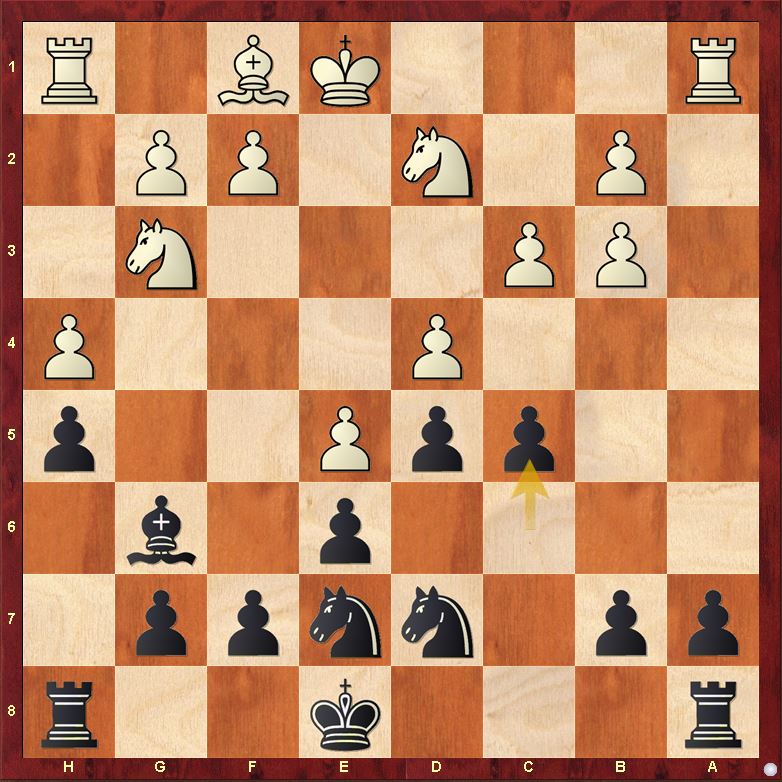
After 11.Qb3, again, I feel that Black doesn't have much choice of non-committal moves. I initiated 11...Qxb3 based on the thinking that I have some potential playing against White's damaged pawn structure on the Queenside, and that my natural follow-up seems to be ...Ne7-f5, but I do not want to face Qa3 which is a "messy" position I do not enjoy. Hence, the decision to simplify through exchanging the Queens off the Board. I do note the drawback that the a7 pawn is pinned, and White enjoys a semi-open a-file without the need to spend a move to develop the Rook on it's original square of a1.
After 11.Qb3 Qxb3 12.axb3, I played 12...c5!? because I felt that I cannot afford to allow White to play b4 first to repair his pawn structure and lock down my ...c5 pawn break. I was prepared for some discomfort / complications arising after something like 13.dxc5 Nxc5 14.Bb5+ or 14.b3. A more ambitious wish is to initiate ...cxd4 and make White suffer with the double-isolated pawns on the b-file.
Engine: The whole business arising from 11...Qxb3 12.axb3 c5!? even though not outright losing, does not seem too good for Black. White could've accepted Black's challenge to enter into complications after 13.dxc5 Nxc5 14.b4 Nd3+ 15.Bxd3 Bxd3 16.Nb3! with space advantage AND freedom of piece development, with at least a small advantage.
Black could've avoided initiating the exchange of Queens and went for 11...c5 immediately (and wait for White to consider initiating the exchange of Queens. Something like 12.Qxb6 axb6 13.Bb5 is quite equal.
13.Nf3 cxd4
14.cxd4 Nf5
15.Nxf5 Bxf5 Diagram

After 13.Nf3, 13...cxd4 was according to Black's intention to double-isolate White's pawns. 14.cxd4 seems better than 14.Nxd4 as 15.Nxe5 Nb5!? 0-0 seems quite good for Black. I chose 14...Nf5 because I wanted to play another "waiting" move -- the Rook on h8 was doing a decent job defending the pawn on h5, and I wasn't sure whether I want to castle at all. I find ...a6 meaningless as if White wants, he could still play Bb5. At least, after ...Ne7-f5, I gained the additional option of ...Ke8-e7. One does not need to castle to connect the backrank Rooks (which some chess experts suggest this mark the end of the opening phase)!
Engine: Black should have played 14...a6 which I found meaningless during the game. Instead of committing to 14...Nf5 which only led to an exchange of pieces, 14...a6 liberates the Rook on a8 of its defensive duties. If White insists on 15.Bb5, now 15...Rc8! and it is Black, not White, who first gains access to the open c-file. The White Bishop on b5 is chased, and if 16.Bxd7+ Kxd7, Black not only has first access to the c-file but also completed opening development thanks to White being so obliging!
16.Kd2!? Ke7!?
17.Bb5 a6
18.Bxd7 Kxd7 Diagram


Both Kings felt safe enough to stay in the centre. After the game, I shared my views that I felt White would've been better to consider something like 17.Bd3 instead. After 17.Bb5, I thought 17...a6 was a great move, since it relieves my a8 Rook of its defensive duties while giving the White Bishop a Kick. I do not mind 18.Bxd7 Kxd7 since my d7 Knight was not doing much anyway.
19.Rhc1 Rac8
20.Rc3! f6!?
21.Rac1 Be4?! Diagram

I actually suggested quite a bit of improvements on both sides after the game ^o^ 20.Rc3 was smart on White's part to fix the pawn structure. I think I was confused with 21.Rac1 -- this exposes Black to White initiating the exchange of Rooks on c8 (even though White continues to "suffer" the double isolated pawn. Instead, I think Black should play 21...Rxc3 and let White decide whether to fix the pawn structure with 22.bxc3 or 22.Rxc3 to play with activity. Black should not be worried as the King on d7 has covered up the c6,c7 and c8 squares, so White Rook cannot penetrate on the c-file. Black can instead, go back to work on Kingside activity with say, ...f6 and only after then, ...Be4.
Engine: 20...f6 felt a bit shaky. To solve Black's problems, indeed 21...Rxc3 should be played. While this allows White to repair his pawn structure, at least Black won't be "tied down" due to the obligation to not exchange.
22.Ne1 fxe5
23.f3 Bf5!?
24.dxe5 Rhg8?! Diagram

These were my post-game thoughts: White could've just initiated double Rook take on take the Black King away from the center. Then White can decide how he wants to play out the Knight-v.s. Bishop endgame. Black was even more imprecise here -- I should've initiated Rxc3 while I still had the chance and only after then, decide on the deployment of the Black Rook and the Bishop on the Kingside. I think Black would be in trouble had White initiated double capture on c8 by virture of King position -- White King is far more centralised and superior.
Also, I think 23...Bg6 is better than 23...Bf5. I played 23...Bf5 to take away the possibility of White initiating g4. But the way Black did things was so slow! At least, after 23...Bg6, Black can do ...Rhf8 to work on the semi-open f-file. In any case, White really should consider initiating double capture on c8 to prove that Black is wasting time on Rh8-h7 (and de-centralise the Black King).
Engine: 23...Bf5 misses a tactical shot: 23...exd4! and after 24.Rxc8 Rxc8 25.Rxc8 Kxc6 26.fxe4 Bxe4 I wrongly evaluated that this is better for White because Black's King is far away. The central pawn mass (essentially, supported and connected pass pawns!) says otherwise! Never stop at general impressions -- calculate in big positions like this! I actually did freeze at this move (I took time to calculate), but I evaluated the arising position wrong.
Also, 24...Bf5 that was played, is much better than 23...Bg6 if White realises that he should exchange both Rooks and push the Black King back: 23...Bg6 24.Rxc8 Rxc8 25.Rxc8 Kxc8 29.dxe5. This is because eventually, Black would need to play ...g7-g6 to chain up with the pawn on h5. Hence, it would be a waste of time to move the Bishop away from g6 and then play ...g6.
25.Ke3 Rxc3
26.Rxc3 g5!?
27.hxg5 Rxg5 Diagram

Luckily, I think Black is finally proceeding in the right direction. The c-file which White Rook is looking at, is actually well-covered by Black -- the Black King on d7 took away the squares for White Rook to penetrate. On the other side of the Board, Black is actually making concrete progress with the Rook on g8. I believe the Rook on g8 must be stronger than the Rook on c3. On hindsight, perhaps White should consider taking the chance to repair the pawn structure, with 26.bxc3 instead. The Rook on c1 is well-positioned to relocate and contest on the other side of the Board / potential open files.
28.f4?! Rg4
29.b4 Be4
30.Nc2 Rxg2! Diagram

On hindsight, 29.f4 felt really unnecessary for White to me. Of course, I couldn't care too much about White's choices here, since I am very low on time. I love my find of 29...Be4 -- the White Knight on e1 is dominated, since every square it can go to is covered by the Black Bishop. After 30.Nc2 which effectively concedes at least a pawn, I know that Black probably has a winning position, but I spent so much time, I only made the move in dying seconds of the game (hence the !, not that the move 30...Rxg2 itself was anything special).
Engine: 28.f4 was indeed the critical blunder which lost the game for White. Interestingly, the best move recommended was 28.Kf4, giving the Black Rook a chase. Position after 28.Kf4 is evaluated as dead equal (0.00).
31.Nd4 Rxg3+
32.Kf2 Rg2+
33.Ke3 Rxb2
0-1
Final position of the game -- White has 25:38 remaining on his clock while Black has (only) 1:09. I guess one thing Blitz really helped me, is the courage to play when low on time. "nerves of steel" when playing under severe time trouble is something I wish to acquire.

Summary of Learning Points
1. Every game and position is unique. One should not be influenced by negative experience of the past (bad Queen placement) But in this game, 7...Qb6! would have secured a huge advantage within the opening phase).
2. Cut down on redundant moves -- 11...Qxb3, 14...Nf5, 24...Rhg8
3. "Do not initiate exchanges which benefit the opponent." is a wrong guideline to follow! The correct understanding should be, "Evaluate exchanges by first considering the outcome of initiating the exchange, followed by the outcome of opponent initiating the exchange, and choose one that makes it best for you / worst for your opponent." In this game, I attribute my bad decision to not initiate the Rook exchange on c3 (repairs White's pawn weakness) to not evaluating what happens when I wait for my opponent initiate the exchange. By "waiting", I end up getting my other Rook stuck and King stuck (as they had to prepare for the recapture on c8) and had White initiated the exchanges on c8, Black would be in trouble because the Black King will be kicked back to the backrank.
4. Black's miss after 23.f3 is a clear sign of lack of basic understanding of imbalance. I can't find any other factor to blame. I simply have to keep an open mind and not rely on generic initial impressions when making a big decision. I even froze at the move to think/calculate, meaning to say I suspect there was something but unfortunately, was unable to see through to it.
5. The outcome was a lucky one for Black. On the bright side, I do like my ability to manage the time pressure towards the end, and I'd say playing a bit of blitz games helps. There's simply no other situation allowing for one to test one's nerves (other than putting oneself under time pressure). Of course, on the other hand, I do feel that I have wasted quite a bit of time without improving the quality of my move -- e.g. I spent a long time and still did not initiate the exchange of Rooks, which is quite bad on my part. See, time spent on a move need not always improve the quality of the move when a player is not asking the correct questions of a position and answering them.
External Link to Game Replay
After sharing this game which I'm rather happy to have played, it's time to share a game that I feel so embarrassed of. With no disrespect to my opponent (a younger adult) who fully deserved the win, I feel that it was more of a game I psyched myself to lose throughout. Hence the reluctance to even acknowledge the existence of this game ^o^ But if a casual club player like myself can't even face a non-consequential defeat in good faith, what right do I have to preach about chess etiquette to others, or criticise the misbehaviour of kids in tournaments? I can at least better understand their misbehaviour, with everything (prize, rating points) on the line. Hence, I have always been tolerant of kids who misbehave in chess. (May my patience not wane with age!)
Game 2: Adult Opponent (Younger) v.s. newbie_learner
Time control: I can't recall for sure, but I think it was something like 25 minutes initial time, with 10 seconds increment per move starting from move 1, considered long for a rapid game (usually in Singapore, we play 15 + 10 or 25 + 0 instead).
1.d4 d5
2.Nf3 Nf3
3.c4 e6 Diagram

I don't know how other chess players feel, but I always find it difficult whenever facing a line which I play it myself =)
4.g3!? Bb4+
5.Bd2 Be7
6.Bg2 0-0 Diagram

4.g3, in Catalan style, is something I used to play a little, but stopped completely for quite a while already. My results with this opening as White were discouraging, and I thought my "general instinct" does not gel with the general demands of the opening. But I do like to play at least a bit experimentally from time to time. On this subject, I am quite in agreement with International Master and famous chess author, Jeremy Silman's general pointers: To maximise (short-term) efficiency, we should stick to what we are most familiar with (e.g. when playing in important tournaments, where things are at stake). But in the long run, we learn the most from playing into positions we do not enjoy or find unfamiliar. If I am not in an experimental mode in casual games, when will I ever have an opportunity switch on my experimental mode? Hence, my choice to play experimentally here.
Of course, one needs to find a delicate balance that works for oneself. If you keep playing experimentally and you keep losing, it may become detrimental to your self-confidence. For now, I am decently happy with my own mixture. So long as I don't lose each and every single game in a chess session, I would be in a mood for experiment. But if I am on a bad losing streak, I will switch back to my "main repertoire" to get a few wins/draws and regain my confidence first.
This 4...Bb4+ 5.Bd2 Be7 manoeuvre is something I have seen quite a bit in both high level chess and when playing training games with local kids. My understanding for the rationale of Black's moves (he Black violated the general opening principles of moving the same piece twice!) is that Black opines that White's dark square Bishop on d2 is misplaced. Hence, by provoking 5.Bd2, White will eventually need time to further improve this misplaced piece. Hence this trades off and justifies Black's loss of time -- In comparison, Black argues that his Bishop is well placed on e7.
As for the move 6.Bg2, it is the most natural -- why would you play g3 otherwise? 6...0-0 is a natural move too. So nothing too out of the blue yet.
7.0-0 dxc5
8.Qa4 a6
9.Qxc4 b5 Diagram

White may seem to be playing like a noob, keep moving his Queen, but from the little I know, this is how the Catalan is supposed to be played (if White is opting to not play with a pawn down). Other than regaining the lost pawn, White will try to provoke weaknesses on Black's Queenside pawns. The focus of the fight is on the Queenside and the centre, hardly the Kingside.
10.Qb3 Bb7
11.a4?! Bd5!
12.Qd1 b4! Diagram

I really hate myself with the 11.a4 blunder. I totally missed the power 11...Nd5 hard counter. Perhaps I was overly optimistic (I had won the first game, this is the second game played with the same opponent), and completely overlooked Black's ideas. From that moment on, I just felt horrible about my position from now on. The idea of 12.Qd1 is to move my Queen out of trouble. I am already unhappy with myself and don't want the Queen to be harassed anymore. Also, 12...b4 is very good in shutting down the Knight on b1.
LiveBook/Engine: 10.Qc2 is better. White has a few ideas, including but not limited to Rc1 (to attack c7), a3 (to stop ...b4 and facilitates Nb1-c3). If the Queen on c2 is harassed by a move like ...Be4, at least White has Qd1. With the f1 Rook brought to c1, this Queen retreat does not impede White from connecting the Backrank Rooks eventually.
13.Qe1 b5
14.Bg5 Nbd7
15.Nbd2 h6 Diagram

When I played 13.Qe1, I was hoping for some potential e2-e4 pawn push. I felt 14.Bg5 was necessary so that I can deploy the b1 Knight to d2. Otherwise, my Knight is stuck and I can't activate my Rook on a1. There is no doubt that White is worse, if not losing.
Engine: There is no doubt White is worse. On hindsight, 13.Qe1 is a waste of time. Instead, just skip this move and play 13.Bg5 immediately. With the White Queen still on d1, it is defending the a4 pawn. White must be prepared to give up the Bishop pair with natural move like e3 and try to strive for a setup that is "playable".
16.Bxf6 Nxf6
17.Rc1 Rc8
18.e3 c5 Diagram

White is trying it's best to catch up. I was uncertain about e4, and decided to play e3 instead, in case the e4 becomes an additional weakness for Black to exploit.
Engine: The verdict comparing 18.e3 to 18.e4 is not so clear. The evaluation slightly prefers e4 as it gains tempo. But this seems to be inherent engine bias. There are clear reasons/merits to consider e3 instead of e4. But if White sees itself as facing a desperate position, a more dynamic move of 18.e4 does seem better to complicate the situation (rather than 18.e3 and allow Black to continue the slow squeeze).
19.Qe2 Qb6
20.b3 Rc7
21.Rc2?! Ne4! Diagram

I did not realise that Black has Ne4-c3. So this is another complete loss of time.
Engine: Much easier is to play just 20.dxc5 -- The biggest threat from White is actually the potential to make a supported pass pawn. So let's kill this possibility when we still can.
22.Nxe4 Bxe4
23.Rcc1?! Rfc8
24.dxc5 Rxc5 Diagram

Engine: White should have tried the intermediate move of 23.dxc5, which makes it more difficult for Black to double Rooks on the c-file first. This will buy White a little bit more option on the fate of the c2 Rook.
25.Rxc5 Qxc5
26.Nd4 Bxg2
27.Kxg2 Bf6 Diagram

Engine: Black should have played this position more forcefully with 27...e5! which kicks the d4 Knight supporting the backward b3 pawn.
And now, in this difficult position (and time situation), White made a huge blunder which ended the game on the spot.
28.Nb5?? Qd5+!
0-1
The b3 pawn drops, Black pawns will promote and so White resigned on the spot. Quite frankly, White's mind was bothered by the position arising after 11...Bd5! throughout the game -- I kept thinking about it and lamenting how bad it was for me to miss it completely. Not saying that I will definitely find the saving 28.Rd1 if my mind was not messed up, but what I see as valuable lesson is that a) games can be lost if you get into a losing mentality, and b) objectively, a position, not matter how bad it may first appear, can be objectively very resilient. I have been repeating this point a lot, but I think the difference in mental resilience is a key difference between a good player and an average / club player.
Okay, I finally found the courage to face this bad loss face to face. There will only be more to come for as long as I continue to play chess. But I'd rather continue to play chess than to avoid the pain of losing a game through retirement from chess play =)
Summary of Learning Points
1. Mental resilience! The correct way to deal with a position, no matter how bad, is to deal with it at it's current state. One should not dwell in what has happened in the earlier moves. Easier said than done, I know.
This is not really a learning point for my own, but I'd like to take this chance to address chess parents who are ultra strict with their own kids just starting to pick up the game -- chess is really very difficult even for experienced / adult players! Hence, please remember to be kind and patient enough with your kids. Remember -- everyone had to go through the "beginner" stage in their bid to improve their game. Worse is to make the game of chess, already difficult to master, unenjoyable for them.
2. Avoid waste moves -- 13.Qe1 was a waste, and good intermediate moves like 23.dxc5 was missed. This should not be missed even in a bad situation. Need to hone the art of damage control, or pick correctly the "lesser of the evil".
3. Mid-endgames, pawn structures, typical weak areas of a club player =(
3. Be brave enough to face your losses, no matter how bad they were, and not just show-off your victories!
External Link to Game Replay
Thanks again.
Yours sincerely
Ong Yujing (Eugene)
a.k.a. newbie_learner
Siglap South CC Chess Quartet
Subscribe to:
Posts (Atom)
Where to Play Chess in Singapore 2021 (COVID times)
It's probably been a year since I updated this chess blog. Due to the current global pandemic, over the board (OTB) chess has been so ba...

-
 At the beginning of the year 2018, I had posted on " Where to Play Chess in Singapore 2018 " on my old chess blog page. (I had to ...
 -
 It's probably been a year since I updated this chess blog. Due to the current global pandemic, over the board (OTB) chess has been so ba...
 -
 Better early than late! I feel obliged to quickly update the information on "where to play chess in Singapore" after seeing Weng C...